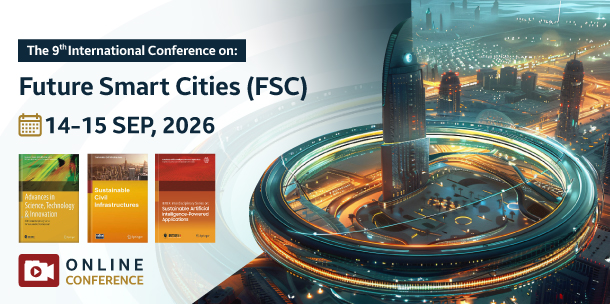
Urban Planning & Architectural ...
Online Conference
20 Oct 2026 / 22 Oct 2026 read more
Nessma Farouk
Conference Coordinator
[email protected]
(+20) 3 5763827 | (+20) 3 5763828
(+20)1000028021
Subscribe to our newsletter
“Architectural conservation is something that embraces not just architecture in all its various forms, but a vast range of other subjects – environmental politics, urban planning, urban economics and tourism, and even war destructions and renewal [...] Conservation is, and has always been, an integral part of modern society and its environment, like all the modern environments, did not just happened.” (Miles Glendinning, 2013)
Building on this understanding, the 11th International Conference on the Conservation of Architectural Heritage (CAH 2027) places Cultural Heritage at Risk at the heart of its discourse. In an era marked by climate change, geopolitical instability, rapid urbanisation, environmental degradation, and socio-economic transformation, cultural heritage is increasingly vulnerable. From historic monuments and cultural landscapes to modernist and industrial sites, heritage is confronted with unprecedented challenges that threaten its material integrity, authenticity, values, and continued relevance.
Within this urgent context, CAH 2027 brings together academics, practitioners, policymakers, and stakeholders from across disciplines to advance practices around the conservation and sustainable development of architectural and urban heritage; it additionally aims to promote practices regarding examining heritage at risk and promoting strategies for the development and management of such heritage to continue its relevance to contemporary debates, values and communities. The conference, therefore, serves as a vital platform for exchanging knowledge, exploring innovative methodologies, and fostering resilient and sustainable approaches to conservation. It highlights the necessity of interdisciplinary collaboration in responding to complex and evolving threats, while reaffirming the essential role of cultural heritage in shaping identity, memory, and social cohesion.
Building upon the success of previous editions, CAH 2027 is organised by a distinguished international consortium including the University of Portsmouth, the University of Cagliari, and the University of Salento. This collaboration underscores the shared global responsibility to safeguard heritage through integrated approaches that combine traditional knowledge, advanced technologies, and robust governance frameworks.
The conference will take place at the European University Centre for Cultural Heritage, in Ravello, a remarkable cultural landscape set high above the Amalfi Coast, where natural beauty and centuries of human craftsmanship converge. Perched on a hilltop looking over the Mediterranean, Ravello is renowned for its historic villas, terraced gardens, and medieval fabric, which together create a setting of exceptional cultural and scenic value. Part of the UNESCO-listed Amalfi Coast, the region reflects a long-standing relationship between communities and a challenging environment, expressed through its architecture, agricultural terraces, and settlement patterns. Hosting the conference in this unique setting situates our discussions within a living example of heritage shaped by resilience, adaptation, and ongoing transformation. The area offers a fascinating setting in which to engage with questions of architectural and urban heritage conservation as well as heritage risk, adaptive reuse, and sustainable futures.
In this context, CAH 2027 engages with cultural and architectural heritage in both its tangible and intangible forms, across landscape, urban, and architectural scales. It recognises that while traditional conservation approaches remain fundamental, they are no longer sufficient on their own. The conference therefore advocates for new frameworks to understand and protect heritage in response to shifting environmental conditions, technological advancements, and evolving social values. It promotes contemporary practices that integrate community perspectives, address inclusivity and accessibility, and respond to the specific challenges of historic, modern and contemporary heritage.
CAH 2027 also reinforces the growing alignment between cultural heritage and the Sustainable Development Goals (SDGs), highlighting the importance of embedding conservation within broader sustainability agendas. Addressing heritage at risk requires not only technical expertise but also ethical, social, and cultural engagement, supported by advances in digital technologies and creative practices.
Within this framework, CAH 2027 encourages additional three interrelated themes:
Theme 1: Cultural Heritage at Risk
This central theme investigates the nature and dynamics of risks affecting heritage worldwide. Topics include vulnerability assessment, disaster preparedness, climate adaptation, conflict and post-conflict recovery, heritage loss and documentation, and the development of policies and governance models for risk management. Contributions may address case studies, methodologies, and theoretical approaches that advance the understanding of resilience and sustainability in heritage conservation.
Theme 2: Modern and Military Heritage: Interpretation and Conservation
This theme focuses on the challenges associated with conserving modern, industrial, and military heritage, which often face accelerated deterioration, contested values, and limited recognition. It explores methods for documentation, interpretation, adaptive reuse, and material conservation, while addressing the socio-political and environmental dimensions of preserving heritage from the 19th, 20th, and 21st centuries. The theme encourages critical reflection on how narratives of modernity, conflict, and memory are constructed and preserved.
Theme 3: Digital and Creative Heritage
This theme examines the transformative role of digital technologies and creative practices in heritage conservation. Topics include advanced documentation techniques such as HBIM and 3D modelling, digital archiving, and the use of immersive media, including virtual and augmented reality, for interpretation and engagement. The theme also considers how digital tools can support risk management, enhance accessibility, and democratise heritage knowledge, while fostering innovative connections between communities and cultural assets.
Together, these themes frame a comprehensive exploration of how heritage can be understood, protected, and reimagined in the face of contemporary risks, ensuring its transmission to future generations.
Scope
The 11th International Conference on Conservation of Architectural Heritage (CAH 2027) provides an interdisciplinary platform for advancing knowledge, practice, and critical dialogue in the conservation and management of cultural heritage within an increasingly complex global context. The conference adopts an inclusive understanding of heritage, encompassing its tangible and intangible dimensions across architectural, urban, and landscape scales, and spanning from archaeological to modern and contemporary environments. It recognises that heritage embodies multiple, overlapping values, historical, cultural, social, environmental, and economic, which must be carefully balanced and sustained over time. The conference addresses key challenges impacting heritage worldwide, including climate change, natural hazards, urban development, tourism, conflict, neglect, and shifting societal perceptions. These dynamics call for renewed reflection on conservation approaches, particularly in relation to authenticity, integrity, and long-term sustainability. Contributions are invited that explore innovative strategies for conservation, preservation, and adaptive reuse, integrating traditional knowledge with contemporary and interdisciplinary methods. A central focus is the development of resilient and informed heritage management, including engagement with policy frameworks, governance models, and institutional roles. The conference also emphasises the importance of community participation, recognising diverse values and lived experiences in heritage stewardship. Finally, the scope extends to the relationships between heritage, sustainability, accessibility, and economic development, as well as the growing role of digital tools in documentation, interpretation, and dissemination. Through this approach, CAH 2027 fosters cross-disciplinary collaboration to support the resilient transmission of cultural heritage to future generations.
1.1. Concepts and Definitions of Heritage Across Cultures, Geographies, and Historical Periods.
1.2. Conservation Theories, Philosophies, and Evolving Practices.
1.3. Authenticity, Integrity, Identity, and Cultural Significance.
1.4. Tangible and Intangible Heritage: Relationships and Interpretations.
1.5. Architectural Phenomenology and Experiential Values of Heritage.
1.6. Heritage Valuation, Interpretation, and Meaning-making Processes.
2.1. Risk Assessment, Vulnerability Analysis, and Resilience Planning.
2.2. Climate Change Impacts (Coastal Erosion, Thermal Stress, Extreme Events).
2.3. Heritage in Conflict, Post-conflict, and Disaster Contexts.
2.4. Emergency Documentation, Safeguarding, and Reconstruction.
2.5. Managing Risks from Urbanisation, Over-tourism, Neglect, and Vandalism.
2.6. Rural Abandonment, Disappearing Landscapes, and Vernacular Heritage.
2.7. Preventive Conservation and Long-term Risk Management Strategies.
2.8. Community-based Risk Preparedness and Rapid Response Approaches.
3.1. Archaeological, Historic, Modern, and Contemporary Heritage.
3.2. Industrial, Military, and Defence Heritage.
3.3. Difficult and Contested Heritage (Dark Heritage, Memory, Trauma).
3.4. Nineteenth- and Twentieth-Century Heritage Conservation Challenges.
3.5. Adaptive Reuse and Transformation Strategies.
3.6. Post-Crisis Reconstruction and Heritage Recovery.
4.1. Advanced Documentation (HBIM, GIS, Digital Archives).
4.2. Photogrammetry, 3D Laser Scanning, and Point-Cloud Modelling.
4.3. Non-Destructive Testing (NDT) And Diagnostic Technologies.
4.4. Artificial Intelligence and Data-Driven Conservation.
4.5. Digital And Immersive Tools (AR, VR, MR) For Interpretation and Monitoring.
4.6. Digital Heritage, Gamification, and Public Engagement.
4.7. Integration Of Digital Tools in Heritage Risk Management.
5.1. International Charters, Legislation, and Conservation Frameworks.
5.2. UNESCO, ICOMOS, and Global Heritage Governance.
5.3. National and Local Policy-Making for Heritage Protection.
5.4. Governance Models, Management Plans, And Funding Mechanisms.
5.5. Public-Private Partnerships (PPPs) and Innovative Financing.
5.6. Role of Institutions, NGOs, and Stakeholders in Conservation.
6.1. Heritage within the Sustainable Development Goals (SDGs).
6.2. Sustainable Urban Regeneration and Historic Urban Landscape (HUL) Approaches.
6.3. Socio-economic Impacts of Heritage Conservation.
6.4. Tourism Pressures, Over-Tourism, and Sustainable Tourism Strategies.
6.5. Adaptive Reuse of Built Heritage and Cultural Landscapes.
6.6. Integration of New Functions within Historic Environments.
7.1. Community Participation and Co-Creation in Heritage Processes.
7.2. Cultural Identity, Belonging, And Social Value of Heritage.
7.3. Inclusivity, Accessibility, and “Heritage for All”.
7.4. Role of Women, Youth, and Underrepresented Groups.
7.5. Migration, Displacement, and Mobile/Ephemeral Heritage.
7.6. Awareness-Raising, Education, and Cultural Transmission.
8.1. Museology and Exhibition Design.
8.2. Storytelling, Media, and Creative Approaches to Heritage Interpretation.
8.3. Cultural Events, Festivals, and Heritage Activation.
8.4. Bridging Tangible and Intangible Heritage Through Creative Practice.
8.5. Innovation in Communication and Public Engagement.

All accepted submissions to the conference, after a rigorous double-blinded peer-review process by the respective Editorial Board, will be published in:
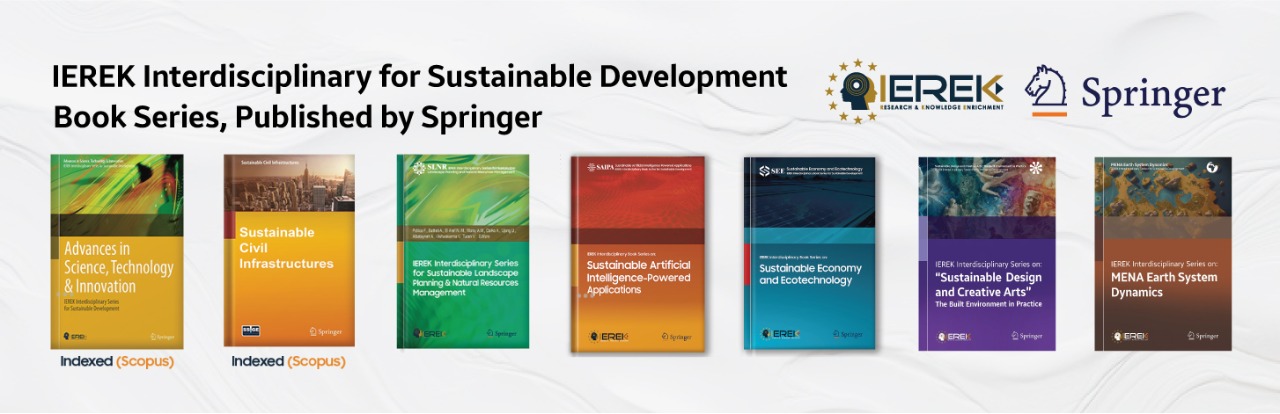
Advances in Science, Technology and Innovation (ASTI), an IEREK interdisciplinary book series published by Springer Nature. (SCOPUS indexed)
Publisher: Springer Nature (IEREK Interdisciplinary book series)
Indexing: SCOPUS indexed; some titles in Web of Science (ISI)
Focus: Emerging research in science, technology, and innovation for sustainable development, addressing UN SDGs.

An IEREK interdisciplinary book series published by Springer Nature, focusing on the built environment in practice.
Publisher: Springer Nature
Focus: Sustainable design, architecture, landscape architecture, urban design, public art, visual and fine arts, creative practices, environmental communication, and interdisciplinary research addressing sustainable and resilient built environments through practical and innovative approaches.
Key Areas: Sustainable Design, Architecture, Landscape Architecture, Urban Design, Creative Arts, Visual Arts, Public Art, Environmental Communication, Eco-Art, Sustainable Materials, Circular Economy, Fashion Design, Interdisciplinary Design Research, and Built Environment Practice.
Internationally peer-reviewed, open access journals published by IEREK Press. Covering a wide range of disciplines including sustainability, architecture, engineering, and environmental sciences.
Journal on:
| Title | Date |
|---|---|
| Abstract Submission Deadline | 20 July 2027 |
| Last Notification for Abstract Acceptance & Approval to present | 30 July 2027 |
| Early Payment Deadline | 30 April 2027 |
| Regular Payment Deadline | 30 June 2027 |
| Late Payment Deadline | 30 July 2027 |
| Paper Submission Deadline | 08 Oct 2027 |
| Notification of acceptance/ rejection of submitted paper | From 30 Jul 2027 |
| Letter of Visa (for delegates who need visa entry) *payment required* | 15 Aug 2027 |
| Conference Program | 15 Aug 2027 |
| Conference Launch | 14 Sep 2027 |
Payments through the website are currently unavailable due to ongoing website enhancements. IEREK offers alternative payment methods, including bank transfer and secure third-party online payment links.
The registration fee does not cover accommodation or travel expenses. A list of accommodation options can be suggested by our team if available. Please contact [email protected] for inquiries.
We recommend that all authors take advantage of the benefits that IEREK offers, including various attendance types, publishing opportunities, and opportunities for discounts and waivers.
We are pleased to inform all applicants that they can use their previous publications to register for an IEREK membership, which offers a special discount.
IEREK offers a special discount to applicants from collaborative universities that have signed an MoU with IEREK to host or co-host one of its conferences.
IEREK also provides special discounts to authors from low and medium-income countries.
The disclosed fees are for the conference participation (Publication is free of charge, but only the conference participants can be considered for publishing in the conference proceedings).
Some of the disclosed conference fees may vary depending on the book series and/or journal(s) presented as a publication outlet, as we encourage submission to newly founded book series and/or journal(s) by presenting a discounted rate for the conference's fees.
IEREK offers many types of registrations that are diverse in registration fees; applicants can choose the type they are familiar with as follows:
Participants who are PhD holders, post-doctoral researchers, and universities’ affiliated professors and experts in the field.
Must provide proof of enrollment in a university by providing an enrollment certificate and/or a valid university ID (with issue/expiry date) etc.
Participants who are not affiliated with universities such as practitioners, policymakers, entrepreneurs, etc.
Have access to the event to enjoy the discussions, coffee breaks, and lunch as a co-author or audience.
IEREK Community members receive 25% off the Regular payment stage.
If you are a returning author, published researcher, institutional partner, or active contributor to IEREK activities, you may be eligible for exclusive Community benefits. Visit the IEREK Community Section to learn more and check your eligibility.
| Type of Registration | Early Payment Deadline 30 Apr 2026 |
Regular Payment Deadline 30 June 2026 |
Late Payment Deadline 30 Jul 2026 |
|---|---|---|---|
| Scopus-indexed ASTI Book by Springer | |||
| Student / Early Career Researcher | 300 € | 350 € | 400 € |
| Academic | 350 € | 400 € | 450 € |
| Professional / Industry | 400 € | 450 € | 500 € |
| Co-author/ Audience | 150 € | 200 € | 250 € |
| Open Access IEREK Press Journals | |||
| Student / Early Career Researcher | 200 € | 250 € | 300 € |
| Academic | 250 € | 300 € | 350 € |
| Professional / Industry | 300 € | 350 € | 400 € |
| Co-author/ Audience | 150 € | 200 € | 250 € |
IEREK offers various types of participation. Applicants can apply for in-person attendance to benefit fully from conference discussions and knowledge exchange.
IEREK also offers virtual attendance for authors to present their research papers online; however, we strongly encourage all applicants to attend the conference in person.
The physical fee covers:
* Each research paper should have one main author who should pay the full fee (Author fees) regardless of attendance. Co-authors, each, have their fees to pay to attend the event. This applies to online attendance as well as physical attendance.
* A research paper fee allows only one author, whether main or co-author, to attend the conference and receive only one conference kit. Extras can be requested for an additional fee.
| Type of Registration | Early Payment Deadline 30 Apr 2026 |
Regular Payment Deadline 30 June 2026 |
Late Payment Deadline 30 Jul 2026 |
|---|---|---|---|
| Scopus-indexed ASTI Book by Springer | |||
| Student / Early Career Researcher | 250 € | 300 € | 350 € |
| Academic | 300 € | 350 € | 400 € |
| Professional / Industry | 350 € | 400 € | 450 € |
| Co-author/ Audience | 100 € | 150 € | 200 € |
| Open Access IEREK Press Journals | |||
| Student / Early Career Researcher | 150 € | 200 € | 250 € |
| Academic | 200 € | 250 € | 300 € |
| Professional / Industry | 250 € | 300 € | 350 € |
| Co-author/ Audience | 100 € | 150 € | 200 € |
IEREK offers virtual attendance, providing authors with a unique link to join the conference sessions and present their papers as per the announced program.
The online fee covers:
* Each research paper should have one main author who should pay the full fee (Author fees) regardless of attendance.
* Co-authors, each, have their fees to pay to attend the event. This applies to online attendance as well as physical attendance.
* If an author is eligible for more than one discount, IEREK will apply only the highest discount. Discounts cannot be combined.
* Authors should contact the conference manager through this email [email protected] to consider the discount and waiving for all the above cases so that the conference manager can provide an exclusive invoice for each case.
Afghanistan, Algeria, Angola, Bangladesh, Benin, Bhutan, Bolivia, Burkina Faso, Burundi, Cabo Verde, Cambodia, Cameroon, Central African Republic, Chad, Comoros, Congo, Congo Dem. Rep., Côte d'Ivoire, Djibouti, Egypt, Eritrea, Eswatini, Ethiopia, Gambia, Ghana, Guinea, Guinea-Bissau, Haiti, Honduras, India, Iran, Jordan, Kenya, Kiribati, Kyrgyz Republic, Lao PDR, Lebanon, Lesotho, Liberia, Madagascar, Malawi, Mali, Mauritania, Micronesia, Mongolia, Morocco, Mozambique, Myanmar, Nepal, Nicaragua, Niger, Nigeria, Pakistan, Papua New Guinea, Philippines, Rwanda, Samoa, Turkey, São Tomé and Principe, Senegal, Sierra Leone, Solomon Islands, Somalia, South Sudan, Sri Lanka, Sudan, Syria, Tajikistan, Tanzania, Timor-Leste, Togo, Tunisia, Uganda, Ukraine, Uzbekistan, Vanuatu, Vietnam, Yemen, Zambia, Zimbabwe
IEREK puts a lot of effort into expediting the peer review process to publish articles as quickly as possible. This requires prompt responses from all authors to the editors' comments, if any. Your swift response is highly appreciated to advance the production process and get your articles online. We prioritize the first author to respond as per our formula. The conference proceedings will be divided into multiple books, with the first one scheduled for publication within 6 months after the conference date. We encourage all authors to aim for publication in the first release.
Registration and financial transactions for this conference are managed through our strategic partners, working in close academic partnership with IEREK to ensure seamless delivery of conference services and publication standards.
Both entities work in close academic partnership with IEREK to ensure the highest standards of financial transparency, conference administration, and publication quality.
IEREK has an unyielding policy regarding plagiarism. We believe that copying/taking the ideas and work of other Authors without permission and credit is fraudulent. The Reviewing committee and IEREK employees have the authority to reject a paper during its reviewing process, based on the paper being subjected to either minor or major plagiarism.
Authors must refer to, and abide by, the following instructions in submitting their abstracts/ papers:
This is not a prerequisite for presenting your work at the conference. Meaning, you can present your submitted abstract without intending to publish your work.
This process can only be initiated after payment completion and confirmation:
Registration
To help the organizers plan for inter-disciplinary dialogue, participants are requested to choose from the conference themes/ Topics upon registration.
They must also refer to, and abide by, the following instructions in registering and submitting their abstracts/ papers:
Types of Participation
Organized from the comfort of your own home, the conference offers a virtual attendance option for your convenience. That said, participants will have a chance to present their abstract/research, online, and have their work considered for publication in the proceedings.
Virtual presenters are required to submit an abstract and extend this abstract following the “author instructions” below and before the deadline (see Important Dates). At least one author must pay the registration fee (see Conference Fees).
For any reason, authors may wish to submit pre-recorded video presentations no later than 15 days prior to the conference. Alternatively, they may wish to record a voice-over PowerPoint presentation for submission to the conference organizers.
Organized at the University of Portsmouth, UK, offering a Physical attendance option for your convenience. That said, participants will have a chance to present their abstract/research, on campus, and have their work considered for publication in the ASTI Series by Springer as part of the conference proceedings.
See Author Instructions and Conference Fees for more information.
3. Non-presenting participant
Non-presenting participants may also wish to attend the conference as Audience Members or Co-authors contributing to an already submitted abstract/ paper.
Attending a conference dramatically enhances both your professional and personal development. They help you sharpen the saw, meet and converse with industry experts, expand your resources and grow your professional network. IEREK Conference will help you:
1. Open Discussions: We bring together leading academic scientists, from different universities and countries, to exchange and share their experiences and research results.
2. Internationally Accredited Certificate: The participants are granted internationally recognized certificates acknowledged by IEREK, the University, and Partnering Organizations.
3. Publication: Selected high-quality manuscripts will be published, after peer review, in the Advances in Science, Technology & Innovation (ASTI) book series by Springer or by IEREK Press Journals, both of which are indexed in world-renowned databases.
4. Research Technologies: Conferences can expand your resources by providing a great opportunity to promote gathered information on new technologies related to your research.
5. Networking: You can engage with industry experts to discuss with them the very latest research projects they could be working on and increase your chances of collaboration in future projects.
6. Academic Reputation: Attending many conferences will make you a known figure in academic circles and an active member of the academic community.
For IEREK's Previous Publications, Please Click here
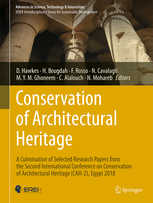
- Conservation of Architectural Heritage (CAH) held on a Nile cruise from Luxor to Aswan in November 2015.

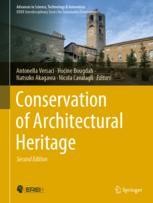
- Conservation of Architectural Heritage (CAH) -2nd Edition held on a Nile cruise from Aswan to Luxor in February 2018.

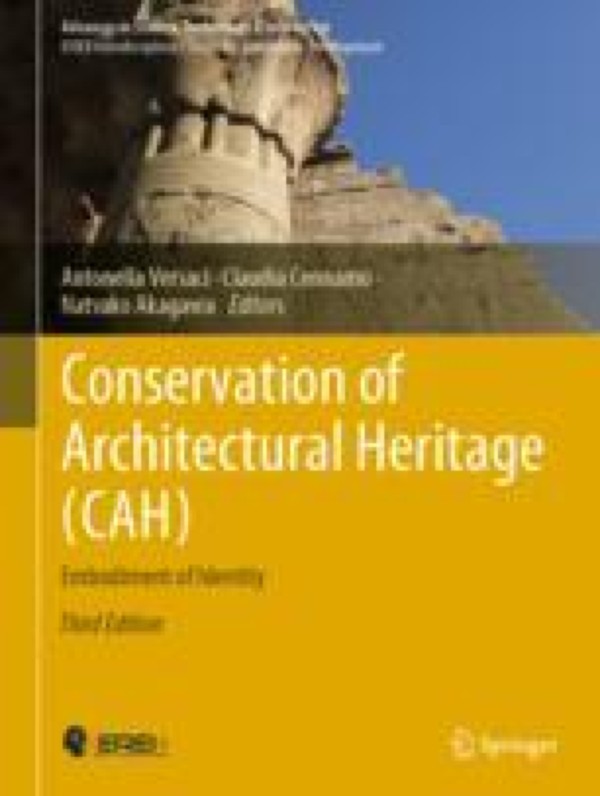
- Conservation of Architectural Heritage (CAH) -3rd Edition held at the Nubian Museum, Aswan in February 2019.

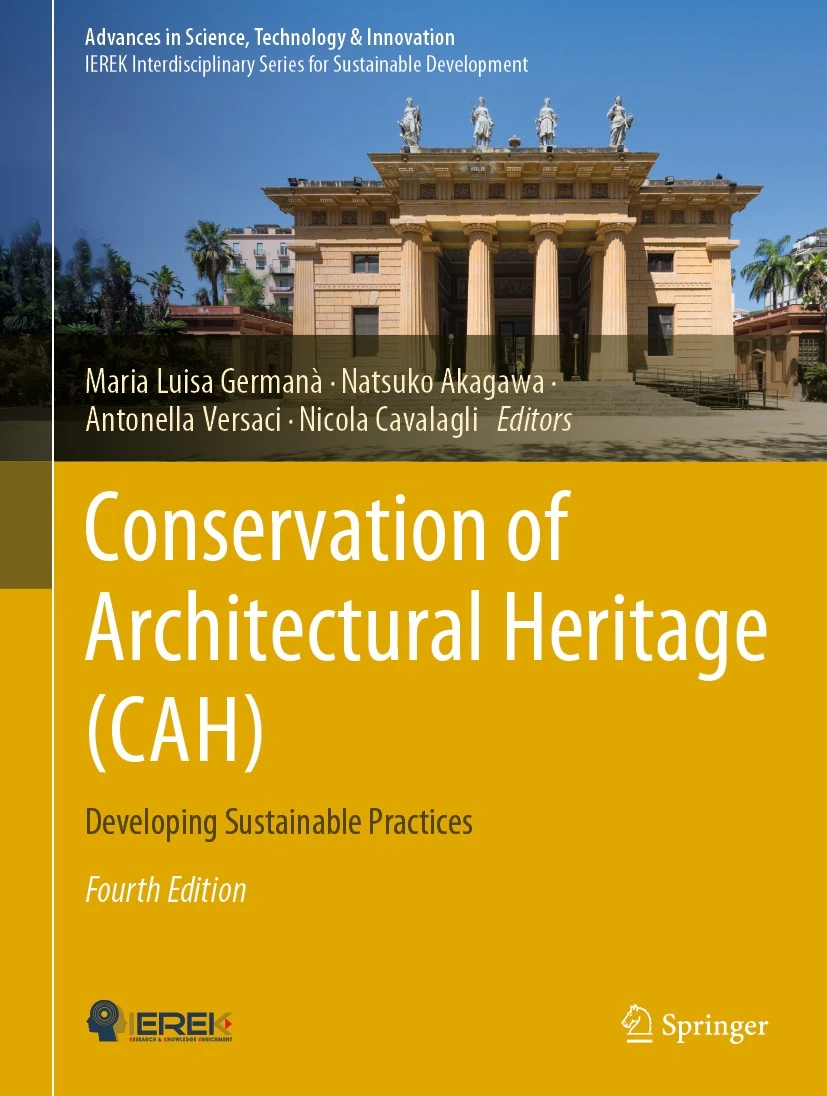
- Conservation of Architectural Heritage (CAH) -4th Edition held on a Nile cruise sailing from Aswan to Luxor in February 2020.

- Conservation of Architectural Heritage (CAH) - 5th Edition held as an Online Conference in February 2021.

- Conservation of Architectural Heritage (CAH) - 6th Edition held as a Hybrid Conference in collaboration with Palermo University, Sicily, Italy in May 2022.

- Conservation of Architectural Heritage (CAH) - 7th Edition held as a Hybrid Conference in collaboration with the University of Portsmouth, UK in Sep 2023.

The International Conference on Conservation of Architectural Heritage was held aboard the Grand Palm Nile Cruise, for 5 days, which had sightseeing trips for the historical, cultural, and architectural sites. As well as holding of the “Folk Art Gallery” by Amr Bayoumi & Ola Bayoumi. The conference was chaired by Professor Douglas C. Comer (the Co- president of ICAHM for ICOMOS.) and organized by IEREK.
The opening session was held onboard the Nile cruise right after the arrival of the delegates and the visit of Luxor temple, which was opened by a welcoming word from the CEO of IEREK. It was then followed by Prof. Douglas C. Comer (the Co- president of ICAHM for ICOMOS.), Prof. Ahmed Rashed (former head of Architecture Department at the British University in Egypt, and the founding director of (CSFS)), Prof. Antonella Versace (Professor at University Kore of Enna, Italy), and finally Mr. Mohamed Badr (Governor of Luxor).
After an introduction about the conference and its delegates was made, the conference officially started with the sessions.
The plenary session titled “Development and Promotion of the Architectural Heritage through Tourism Forms” was run by the following professors:
– Prof. Douglas Comer (Principal, Cultural Site Research and Management, Inc. “CSRM” & Conference Chairman)
-Prof. Antonella Versaci (Kore University of Enna, Italy & Scientific Coordinator of the Conference)
-Prof. Ahmed Rashed (British University in Egypt “BUE”)
-Dr. Monica Hanna (American University in Cairo “AUC”, Egypt)
-Dr. Mohammed Assem Hanafy (University of Alexandria, Egypt)
-Hamdy Elsetouhy (Researcher and Specialist in Conservation)
The first day included a guided tour to Luxor temple. Later there was an optional trip to the light and sound show at Karnak Temple.
On the second day, the delegates moved to the west bank of Luxor to visit the Colossi of Memnon, Hatshepsut’s Temple, as well as an Alabaster factory and bought some alabaster-made souvenirs. Later, there was an optional trip to the Valley of the Kings.
The third day included a visit to Edfu temple in Edfu city, followed later by a visit to Kom Ombo temple when the Nile Cruise reached the city of Kom Ombo. The fourth and last day was spent in Aswan where visits were made to the High Dam, a modern-age site, followed by a visit using motor boats to Philae Temple on Agilkia Island. Following that, the attendees were given the option to visit the botanical island and a Nubian village.
Check this conference’s overview here:
https://www.ierek.com/events/conservation-architectural-heritage-cah#overview
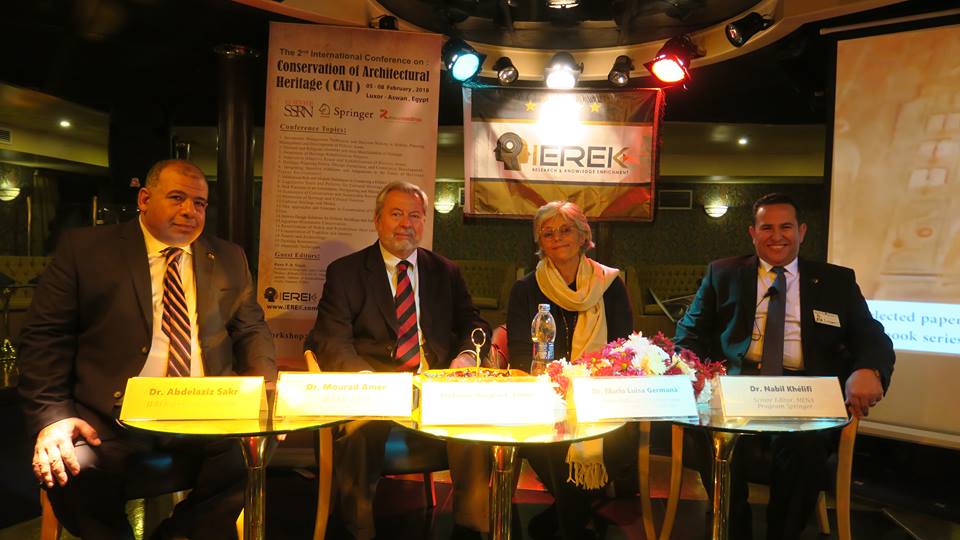
The 2nd International conference on the Conservation of Architectural Heritage in Egypt has been successfully held in Aswan: one of the most significant historical cities existing today.
This conference witnessed the attendance of planners, environmentalists, archeologists, architects, engineers, tourists, policy makers and stakeholders who are interested in the conservation of architectural heritage. Having been filled with participants from diversified fields, approximately 80 full paper submissions were received and 50 of them were presented over several sessions.
Authors attending came from different backgrounds and cultures to discuss research on the conservation of archaeological, architectural and urban landscapes, and multi-disciplinary research on complex Cultural Heritage sites. Held on a Nile Cruise that Sailed from Aswan to Luxor, the conference was attended by authors from Australia, Kuwait, Lebanon, Saudi Arabia, Greece, Egypt and more. With Professor Douglas C. Comer, an archaeologist and the co-president of the United States Committee for ICOMOS (US/ICOMOS), as the Chairperson of the conference, promising conclusions have been reached and recommendations made.
The first day included a guided tour to Luxor temple. Later there was an optional trip to the light and sound show at Karnak Temple.
On the second day, the delegates moved to the west bank of Luxor to visit the Colossi of Memnon, Hatshepsut’s Temple, as well as an Alabaster factory and bought some alabaster-made souvenirs. Later, there was an optional trip to the Valley of the Kings.
The third day included a visit to Edfu temple in Edfu city, followed later by a visit to Kom Ombo temple when the Nile Cruise reached the city of Kom Ombo. The fourth and last day was spent in Aswan where visits were made to the High Dam, a modern-age site, followed by a visit using motor boats to Philae Temple on Agilkia Island. Following that, the attendees were given the option to visit the botanical island and a Nubian village.

Check this conference’s overview here:
https://www.ierek.com/events/conservation-architectural-heritage-cah-2#overview
The 3rd International Conference on “Conservation of Architectural Heritage (CAH)” was held from on 19th to 22nd of February 2019 in association with Faculty of Engineering at Shoubra - Benha Unversity. The conference included many discussions, covered extremely important topics, and presented new scientific values in the scope of conserving the architectural heritage. For the third time, it was a very successful conference that cannot be forgotten.
The international conference was held in Aswan, Egypt, specifically at The Nubian Museum, which is considered to be a gateway to the history of Nubia and one of the most attractive touristic sites in Aswan.
This year, the conference was held under the patronage of Dr. Khaled Abdel Ghaffar (Minister of Higher Education and Scientific Research), Prof. Hussein El-Maghraby (President of Benha University), and The Supreme Council of Antiquities. It was also chaired by Prof. Ragab Megahed (Dean of Faculty of Engineering at Shoubra - Benha Unversity).
First Day: Opening Ceremony and Keynote Speeches
The opening ceremony started with greetings and short-introductions by:
Prof. Tarek Tawfik, General Director of the Grand Egyptian Museum
Prof. Ferdinando Trapani, Associate professor in Urban Planning, Università degli Studi di Palermo, Italy
Prof. Francesco Alberti, Associate professor of Urban planning and design at University of Florence, DIDA - Department of Architecture
Prof. Hussein El-Maghraby, President of Benha University
Dr. Abdel Moneim Saeed, General Director of Aswan and Nubian Antiquities
Dr. Ossama A.W Abd El Maguid, The Head Director of Nubia Museum
The opening ceremony witnessed highly-important speeches especially by the 2 Italian professors Ferdinando Trapani & Francesco Alberti who stressed on the necessity of collaboration and knowledge exchange between Egypt & Italy in the scope of conservation and preservation. The professors also presented the model of "conservation of heritage in Palermo" at the conference, which is considered a living example of exchanging knowledge between 2 great civilizations.
After the lunch break, authors (researchers) started to present a demo of their research paper in oral presentations while session chairman and moderators listen, discuss, and evaluate.
Second Day: The Parallel Sessions Continued & Start of the Workshop
Starting from the 2nd day, remaining authors (researchers) continued presenting their research papers while other participants (students) joined the accompanying workshop titled “Site Management of The Archaeological Sites”.
This workshop examined the interchangeable relationship between the archaeological sites and the historic monuments, and how they affect each other.
At the Nubian Museum, the workshop students obtained great lectures by well-known professors from the University of Benha, such as Prof. Khaled Abd El Hady, Prof. Mostafa Atalla, Prof. Amr Hanafy, Dr. Mona yehia, and Prof. Sadek Saad.
Third Day: Workshop Continued & Site Visit
The day started early with a tour visit to The Unfinished Obelisk (The largest known ancient obelisk and is located in the northern region of the stone quarries of ancient Egypt in Aswan), where a lecture was given by Prof. Khaled Abd El Hady, in addition to group work with participants.
Another tour visit to Temple of ISIS was also organized. Moreover, after lunch, the last visit was made to The Temple of Kom Ombo where all workshop participants enjoyed the scenes and gained a lot of knowledge about heritage in Egypt.
Fourth Day: Pin Up Presentation
At The Nubian Museum, many discussions and group work feedback have taken place regarding what they have seen and learned through this conference and accompanying workshop.
Finally, group photos of all conference participants were taken.
Check this conference’s overview here:
The 4th International Conference on the Conservation of Architectural Heritage in Egypt has been successfully held in Aswan: one of the most significant historical cities existing today.
This conference witnessed the attendance of planners, environmentalists, archeologists, architects, engineers, tourists, policymakers, and stakeholders who are interested in the conservation of architectural heritage. Having been filled with participants from diversified fields, approximately 60 full paper submissions were received and 30 of them were presented over several sessions.
Authors attending came from different backgrounds and cultures to discuss research on the conservation of archaeological, architectural and urban landscapes, and multi-disciplinary research on complex Cultural Heritage sites. Held on a Nile Cruise that Sailed from Aswan to Luxor. The conference was attended and moderated by the Stella kostopoulou from the Aristotle University of Thessaloniki (AUTh), Greece.
It was also moderated by:
Fabio Pollice from the University of Salento, Lecce, Italy.
Ferdinando Trapani from the University of Palermo, Palermo, Italy.
Luca Lanini from the University of Pisa, Pisa, Italy.
The first day was spent in Aswan where visits were made to the High Dam, a modern-age site, followed by a visit using motorboats to Philae Temple on Agilkia Island. Following that, the conference opening ceremony.
The second day included a visit to Kom Ombo temple when the Nile Cruise reached the city of Kom Ombo followed later by a visit to Edfu temple in Edfu city,
The third day included a guided tour to the Luxor temple and Karnak Temple.
On the last day, the delegates moved to the west bank of Luxor to visit the Colossi of Memnon, Hatshepsut’s Temple, as well as an Alabaster factory and bought some alabaster-made souvenirs. Later, a trip to the Valley of the Kings.
Check this conference’s page here:
- For participants who need Entry Visas to the country where the conference will be held, IEREK will issue the corresponding invitation letter for accepted applicants to facilitate visa issuance.
- Please notice that we will endeavor to assist you in obtaining a visa but the responsibility is yours and the decision rests solely with the appropriate Embassy.
Invitation Letter Issuance Process
1- In case the participant is an author who has submitted a research paper to the conference, it must get accepted by the Scientific Committee
2- Required participation fees must be paid
3- The participant should send the following information to the conference's official email:
* A clear copy of passport
* Passport number
* Full name as written in your passport.
* Date of Issuing and Expiration
* Date of Birth
* Email address of the nearest Embassy/Consulate to you
* Mobile Number including country code
4- Conference coordinator will issue the needful invitation letter and send a copy to the participant's email, in addition to another one to the corresponding email address of embassy/consulate
5- The participant should print out the invitation letter along with all other required documents by the embassy/consulate and apply for VISA
|
Cancellation Policy |
Up to 60 days before the event |
Up to 50 days before the event |
Up to 40 days before the event |
39 days before the event |
|
Penalty |
20% |
50% |
70% |
100% |
EXCEPTION
A refund is not possible if
-An acceptance letter has been issued (Authors only)
-The proceedings of the event have been published (Authors only)
-All matters have been finalized (accommodation/travel expenses paid for)
-A visa invitation letter has been issued (All participants)
Visa Rejection Cases
Reason and proof of rejection must be submitted. If the reason for rejection is due to an error on our part, the participant will be refunded their full fee with a deduction of a 20% administration fee.

Documents to be issued by IEREK to acquire a visa are as follows:
*Final Acceptance Letter (Authors only)
*Visa Invitation Letter
*Invoice/proof of payment
We encourage all authors and attendees to ensure their having acquired all documents (those applicable) mentioned.
If the reason for rejection is not related to any of the aforementioned and is an error on the participant’s part, the following will apply:
*Authors: may choose to let their co-author present his/her research on his/her behalf free of charge. If the author does not have a co-author, a member of the scientific committee shall present on the author’s behalf.
*Audience members/Registrants: will only be allowed to attend another similar event of their choosing that is organized by IEREK free of charge.
Nessma Farouk
Conference Coordinator
[email protected]
(+20) 3 5763827 | (+20) 3 5763828
(+20)1000028021
Subscribe to our newsletter
Join IEREK community