Disrupting for Good: AI, ...
Online Conference
28 Jan 2026 / 29 Jan 2026 read more

Prof. Anas Y. AL-HAYAWI
PhD in Genetics, Department of Biology, Tikrit University, Iraq

Prof. Khalid Hashim
Built Environment and Sustainable Technologies (BEST) Research Institute, Liverpool John Moores University, Liverpool, UK
Conference Coordinator
[email protected]
(+20) 3 5763827 | (+20) 3 5763828
Whatsapp: (+20)1000028021
Subscribe to our newsletter
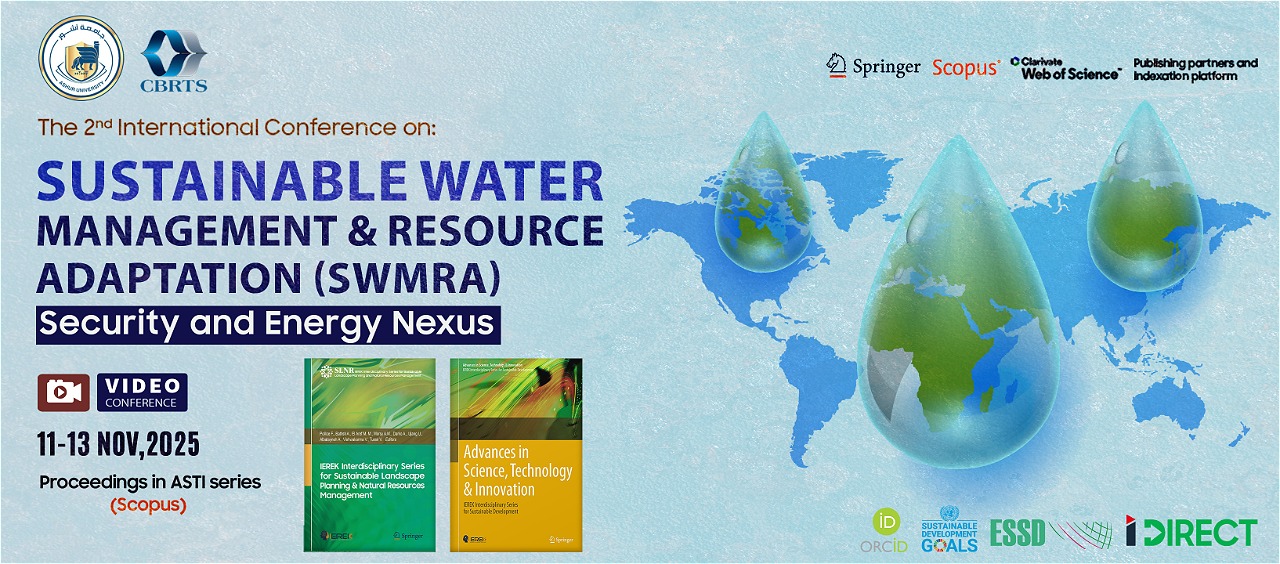
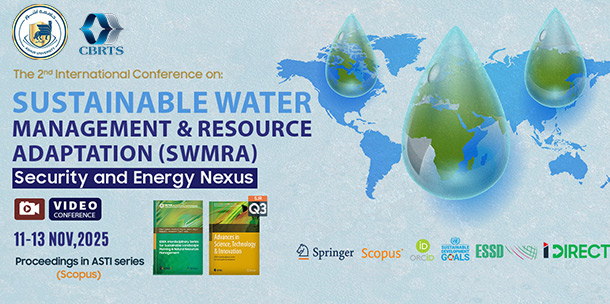
This edition of SWMRA 2025 has been shifted to the next year’s edition, SWMRA 2026, which will be held from June 17–18, 2026, in Rome, Italy.
Water is an essential element for life on Earth. It is not only vital for the survival of everything on Earth, but also for the functions of ecosystems, agriculture, industries, and overall human development. Water also plays a crucial role in maintaining our bodily functions, regulating body temperature, and facilitating the transportation of nutrients. In addition to that, water is an essential component in agriculture, sustaining crop growth and ensuring food security. It is also indispensable in various industrial processes, such as manufacturing, energy production, and waste management. Furthermore, water serves as a habitat for countless species, supporting diverse ecosystems and biodiversity. Recognizing the value of water and implementing sustainable practices is essential to ensure its availability for future generations and to protect the health and well-being of our planet.
Water management plays a crucial and primary role in ensuring the sustainability and availability of resources. It encompasses various practices and strategies aimed at efficiently using, conserving, and protecting water sources. The importance of water management cannot be overstated, as it directly affects various aspects of our lives. Proper management helps meet the growing demand for clean drinking water, supports agricultural activities, and sustains ecosystems. Additionally, it lessens the risks of water scarcity, droughts, and floods, which can have devastating consequences on communities and the environment. By implementing effective water management practices, we can ensure a more secure and resilient future for generations to come.
Those reasons are why IEREK is continuing the conversation about water in its second edition of the Sustainable Water Management, and Resource Adaptation (SWMRA) conference. To highlight the importance of recognizing the value of water and implementing sustainable practices, and how it is essential to ensure its availability for future generations and to protect the health and well-being of our planet.
The conference on "Sustainable Water Management and Resource Adaptation" aims to bring together researchers and professionals from all over the world and from various disciplines to discuss and exchange knowledge on the challenges and solutions related to sustainable water management and resource adaptation. This conference will provide a platform to explore the interdisciplinary approaches and innovative strategies necessary to address the complex issues surrounding water ecosystems, the management of water and resources around it, as well as the application of modern technology, AI, and IoT in water sciences. The conference welcomes research contributions, case studies, and innovative ideas that address the challenges and opportunities in sustainable water management and resource adaptation. It aims to encourage collaboration, knowledge sharing, and networking among attendees to advance sustainable practices and ensure the long-term health and availability of water resources for future generations.
The purpose of the conference on "Sustainable Water Management and Resource Adaptation" is to provide a platform for researchers to come together and address the pressing challenges related to water ecosystems and resources. The ultimate goal of the conference is to promote sustainable practices and innovative solutions for the effective management and adaptation of water resources. Through this conference, IEREK aims to make way for meaningful discussions and explore research on different multidisciplinary topics. By bringing together experts from global backgrounds, the aim is to generate comprehensive insights into the complex interplay between humans, organisms, and the environment in the context of water ecosystems.
Ultimately, the conference on "Sustainable Water Management and Resource Adaptation", and the publication of its selected proceedings aim to contribute to the global efforts in achieving the United Nations' Sustainable Development Goals, particularly Goal 6: Clean Water and Sanitation. By bringing together experts, we seek to inspire and empower individuals and communities to take action toward a more sustainable future, where water resources are managed responsibly, and ecosystems and human health thrive.
1.1. Nanotechnology in filtration and desalination
1.2. Advanced materials for removing heavy metals and pollutants
1.3. Graphene and carbon-based solutions in water treatment
1.4. Membrane technologies for efficient purification
1.5. Quantum dots for water sensing and purification
1.6. Environmental risks and lifecycle impact of nanotechnology
1.7. Photocatalytic nanomaterials for water disinfection and pollutant degradation
1.8. Sustainable recovery and reuse of nanomaterials
1.9. Bio-inspired and green synthesis of nanomaterials for water purification
1.10. Integration of nanomaterials with artificial intelligence for smart water management
2.1. Microplastics, PFAS, and pharmaceutical residues in water
2.2. Advanced detection and monitoring technologies
2.3. Biological and chemical treatment solutions
2.4. Risk assessment for pollutants on ecosystems and health
2.5. Non-target and suspect screening for novel contaminants
2.6. Public health impacts of water quality issues
2.7. Green chemistry for reducing contaminant generation
2.8. Transformation products of contaminants and their ecological risks
2.9. Advanced oxidation and electrochemical processes for contaminant removal
2.10. Linking emerging contaminants to biodiversity loss in aquatic habitats
3.1. Role of climate change in water security and resource variability
3.2. Water diplomacy and conflict resolution in shared basins
3.3. Integrated water resource management models
3.4. Community-based water security initiatives
3.5. Managing transboundary water systems
3.6. Innovative approaches to water scarcity mitigation
3.7. Digital technologies and data-driven solutions for water management
3.8. Innovative financing for water security infrastructure
3.9. Resilience planning for water infrastructure in the face of extreme events
3.10. Case studies in global water governance
4.1. Smart water management for urban areas
4.2. Decentralized water treatment in rural communities
4.3. Innovations in stormwater harvesting and reuse
4.4. Water reuse strategies for urban sustainability
4.5. Infrastructure resilience to floods and droughts
4.6. Nature-based solutions for urban water management
4.7. Balancing water demand and supply in growing urban and rural populations
4.8. Adapting aging water infrastructure for modern needs
4.9. Smart metering and IoT-based monitoring in rural water management
4.10. Public health impacts of inadequate water systems in rural areas
5.1. Protecting biodiversity in rivers and wetlands
5.2. Environmental DNA (eDNA) for aquatic biodiversity assessment
5.3. Wetland restoration strategies
5.4. Indigenous knowledge in ecosystem conservation
5.5. Climate change impacts on freshwater ecosystem health
5.6. Global case studies on freshwater biodiversity
5.7. Hydropower development and its ecological consequences
5.8. Restoring ecological connectivity and riverine processes
5.9. Impacts of urbanization on freshwater ecosystems and riparian buffers
5.10. Monitoring and managing freshwater biodiversity with remote sensing technologies
6.1. Circular economy approaches in wastewater reuse
6.2. Energy-efficient purification technologies
6.3. AI and IoT applications in water treatment
6.4. Desalination innovations for cost and energy reduction
6.5. Decentralized water systems for emergencies
6.6. Bio-electrochemical systems for wastewater and resource recovery
6.7. Next-generation desalination technologies
6.8. Photocatalysis-driven water treatment using renewable energy
6.9. Self-cleaning and anti-fouling technologies for water treatment systems
6.10. Solar-powered water treatment solutions for remote areas
7.1. Strategies for adapting water systems to climate variability
7.2. Mitigating drought and flood impacts globally
7.3. Climate modeling and hydrological forecasting for proactive management
7.4. Infrastructure adaptation to extreme weather
7.5. Social equity and just transitions in climate adaptation
7.6. Case studies on climate-resilient infrastructure
7.7. Impact of glacier and snowmelt changes on water availability
7.8. Role of nature-based solutions in building water system resilience
7.9. Innovative financing mechanisms for climate-resilient water infrastructure
7.10. Urban heat islands and their effect on water demand and availability
8.1. Integrating water, energy, and agriculture demands
8.2. Renewable energy solutions for water management
8.3. Reducing water use in energy production
8.4. Nexus-driven policymaking for sustainability
8.5. Sustainable farming and irrigation innovations
8.6. Digital tools for nexus analysis and decision-making
8.7. Monitoring tools for evaluating nexus performance and efficiency
8.8. Water footprint and energy footprint assessments in food systems
8.9. Circular economy approaches in nexus resource management
8.10. The Water-Energy-Food-Ecosystems (WEFE) Nexus
9.1. Innovations in irrigation systems for efficient water use
9.2. Managing agricultural runoff and its impacts
9.3. Precision agriculture technologies for water conservation
9.4. Using reclaimed water in farming practices
9.5. Agroecology and climate-smart agriculture
9.6. Regional strategies for water-efficient agriculture
9.7. Economic incentives for farmers adopting water-efficient technologies
9.8. Resilient agricultural practices for arid and semi-arid regions
9.9. Groundwater governance and sustainable abstraction
9.10. Integration of organic farming with sustainable water practices
10.1. Renewable energy-powered water treatment systems
10.2. Green technologies for wastewater management
10.3. Digitalization and AI for energy optimization in water utilities
10.4. Environmental impacts of large-scale water projects
10.5. Carbon-neutral strategies in water infrastructure
10.6. Lifecycle assessments of water-energy systems
10.7. Utilizing thermoelectric systems in water treatment and cooling
10.8. Reducing greenhouse gas emissions from hydrological interventions
10.9. Climate-carbon-water nexus and blue carbon initiatives
10.10. Integration of geothermal energy in water heating and treatment systems
11.1. Real-time water quality monitoring with AI
11.2. Remote sensing for hydrological and environmental studies
11.3. Predictive analytics in water resource management
11.4. Blockchain for water use transparency and accountability
11.5. Smart sensors and IoT in global water networks
11.6. Integrating open-source data for collaborative research
11.7. Advanced analytics for non-revenue water (NRW) detection
11.8. Integration of hydrological data with climate forecasting models
11.9. Data interoperability and governance for water platforms
11.10. Digital twins for comprehensive water system management
| Title | Date |
|---|---|
| Abstract Submission Deadline | 30 Aug 2025 |
| Last Notification for Abstract Acceptance & Approval to present | 05 Sep 2025 |
| Early Payment Deadline | 20 Jun 2025 |
| Regular Payment Deadline | 20 Sep 2025 |
| Paper Submission Deadline | 30 Sep 2025 |
| Notification of acceptance/ rejection of submitted paper | 10 Oct 2025 |
| Late Payment Deadline | 10 Oct 2025 |
| Conference Program | 11 Oct 2025 |
| Conference Launch | 11 Nov 2025 |
We recommend that all authors take advantage of the benefits that IEREK offers, including various attendance types, publishing opportunities, and opportunities for discounts and waivers.
We are pleased to inform all applicants that they can use their previous publications to register for an IEREK membership, which offers a special discount.
IEREK offers a special discount to applicants from collaborative universities that have signed an MoU with IEREK to host or co-host one of its conferences.
IEREK also provides special discounts to authors from low and medium-income countries.
The disclosed fees are for the conference participation (Publication is free of charge, but only the conference participants can be considered for publishing in the conference proceedings).
Some of the disclosed conference fees may vary depending on the book series and/or journal(s) presented as a publication outlet, as we encourage submission to newly founded book series and/or journal(s) by presenting a discounted rate for conferences’ fees
IEREK offers many alternative venues for publication. All accepted submissions to the conference, after a rigorous double-blinded peer-review process by the respective and highly-distinguished Editorial Board, will be published through one of the following venues:
Selected papers (according to the preference of the author) will be published in one of the Scopus-indexed or Web of Science-indexed book series or through related journal special issues. See the publishing opportunities section.
Accepted papers (according to the preference of the author) will be published through the Springer book series or through a special issue in one of the IEREK press open-access Journals.
IEREK offers many types of registrations that are diverse in registration fees; applicants can choose the type they are familiar with as follows:
Participants who are PhD holders, post-doctoral researchers, and universities’ affiliated professors and experts in the field.
Must provide proof of enrollment in a university by providing an enrollment certificate and/or a valid university ID (with issue/expiry date) etc.
Participants who are not affiliated with universities such as practitioners, policymakers, entrepreneurs, etc.
Have access to the event to enjoy the discussions, coffee breaks, and lunch as a co-author or audience.
An author may need to attend the conference for presentation only to present a research idea without publication or full paper submission; the fee in this case will be decreased.
| Type of Registration | Early Payment Deadline 20 Jun 2025 |
Regular Payment Deadline 20 Sep 2025 |
Late Payment Deadline 10 Oct 2025 |
|---|---|---|---|
| Scopus indexed-ASTI Book by Springer | |||
| Student | 300 € | 350 € | 400 € |
| Academic | 350 € | 400 € | 450 € |
| Professional | 400 € | 450 € | 500 € |
| Co-author/ Audience | 100 € | 150 € | 200 € |
| SLNR Book by Springer | |||
| Student | 250 € | 300 € | 350 € |
| Academic | |||
| Professional | |||
| Co-author/ Audience | 100 € | 150 € | 200 € |
| Open Access IEREK Press Journals | |||
| Student | 200 € | 250 € | 300 € |
| Academic | 250 € | 300 € | 350 € |
| Professional | 300 € | 350 € | 400 € |
| Co-author/ Audience | 100 € | 150 € | 200 € |
IEREK offers virtual attendance, providing authors with a unique link to join the conference sessions and present their papers as per the announced program.
IEREK is dedicated to optimizing the benefits for each delegate so, similar to physical attendance, when it comes to virtual attendance IEREK also provides two venues for publication, which are:
Type 1:
Online attendance + Publication through Scopus and Web of Science indexation Through IEREK – Springer Nature Interdisciplinary book series “Advances in Science, Technology, and Innovation” ASTI, see previous publications here.
Type 2:
The online fee covers:
* Each research paper should have one main author who should pay the full fee (Author fees) regardless of attendance.
* Co-authors, each, have their fees to pay to attend the event. This applies to online attendance as well as physical attendance.
* Participants can use only one type of discount opportunity, which meets their preferences.
* Authors should contact the conference manager through this email [email protected] to consider the discount and waiving for all the above cases so that the conference manager can provide an exclusive invoice for each case.
| Afghanistan, Algeria, Angola, Bangladesh, Benin, Bhutan, Bolivia, Burkina Faso, Burundi, Cabo Verde, Cambodia, Cameroon, Central African Republic, Chad, Comoros, Congo, Congo Dem. Rep., Côte d'Ivoire, Djibouti, Egypt, Eritrea, Eswatini, Ethiopia, Gambia, Ghana, Guinea, Guinea-Bissau, Haiti, Honduras, India, Iran, Jordan, Kenya, Kiribati, Kyrgyz Republic, Lao PDR, Lebanon, Lesotho, Liberia, Madagascar, Malawi, Mali, Mauritania, Micronesia, Mongolia, Morocco, Mozambique, Myanmar, Nepal, Nicaragua, Niger, Nigeria, Pakistan, Papua New Guinea, Philippines, Rwanda, Samoa, São Tomé and Principe, Senegal, Sierra Leone, Solomon Islands, Somalia, South Sudan, Sri Lanka, Sudan, Syria, Tajikistan, Tanzania, Timor-Leste, Togo, Tunisia, Uganda, Ukraine, Uzbekistan, Vanuatu, Vietnam, Yemen, Zambia, Zimbabwe |
iDirect is a new and efficient platform that allows direct submissions of research papers across various fields of science. iDirect accepts and covers all fields of science, not only those related to a particular conference. Individual authors are encouraged to submit their research discussing new ideas and presenting solutions to everyday problems that fall under numerous scientific themes. The iDirect platform is integrated into the peer review system for online conferences. You can publish your work through iDirect without the need to attend the conference or adhere to any submission deadlines. iDirect accepts a wide range of disciplines, eliminating the need to align with the conference's specific theme or scope. Based on the scope of your research, we will identify the most relevant proceedings for publication. The editor will schedule a discussion with you to review your presentation before proceeding to the peer-review process. Learn more here!
IEREK puts a lot of effort into expediting the peer review process to publish articles as quickly as possible. This requires prompt responses from all authors to the editors' comments, if any. Your swift response is highly appreciated to advance the production process and get your articles online. We prioritize the first author to respond as per our formula. The conference proceedings will be divided into multiple books, with the first one scheduled for publication within 6 months after the conference date. We encourage all authors to aim for publication in the first release.
All accepted submissions to the conference, after a rigorous double-blinded peer-review process by the respective and a highly-extinguished Editorial Board, will be published in one of the following:

Advances in Science, Technology and Innovation (ASTI), an IEREK Interdisciplinary book series published by Springer Nature. (Scopus indexed) About ASTI
Advances in Science, Technology & Innovation (ASTI) is a series of peer-reviewed books based on important emerging research that redefines the current disciplinary boundaries in science, technology and innovation (STI) in order to develop integrated concepts for sustainable development. It not only discusses the progress made towards securing more resources, allocating smarter solutions, and rebalancing the relationship between nature and people, but also provides in-depth insights from comprehensive research that addresses the 17 sustainable development goals (SDGs) as set out by the UN for 2030.
The series draws on the best research papers from various IEREK and other international conferences to promote the creation and development of viable solutions for a sustainable future and a positive societal transformation with the help of integrated and innovative science-based approaches. Including interdisciplinary contributions, it presents innovative approaches and highlights how they can best support both economic and sustainable development, through better use of data, more effective institutions, and global, local and individual action, for the welfare of all societies. The series particularly features conceptual and empirical contributions from various interrelated fields of science, technology and innovation, with an emphasis on digital transformation, that focus on providing practical solutions to ensure food, water and energy security to achieve the SDGs. It also presents new case studies offering concrete examples of how to resolve sustainable urbanization and environmental issues in different regions of the world. Read More.
The ASTI series is fully indexed in Scopus and any chapter/ paper published as part of this series will be seen on the Scopus database. Some titles have been successfully indexed or submitted for indexation in Web of Science (ISI).
About SLNR
Sustainable Landscape Planning and Natural Resources Management (SLNR) is a peer-reviewed book series that presents groundbreaking research through the intersection of two main areas that of which are ‘Sustainable Landscape Planning’ and ‘Natural Resources Management’. The series initially covers a wide range of academic disciplines in sustainability, including landscape ecology, green urbanism, urban regeneration, land restoration and renaturation, energy management, and nature conservation. Moreover, it also incorporates the latest developments and research in engineering topics that contribute to more sustainable cities, such as Geosciences, infrastructure, civil engineering, geology, mining, water, and natural resources conservation and management.
By showcasing methods for discovering, managing, and employing natural resources, the series aims to provide approaches that enable the responsible use of these resources. Ultimately, the SLNR series is committed to advancing the United Nations' Sustainable Development Goals for 2030. Read More.

IEREK Press Journals, a multidisciplinary publisher that aims to cultivate and disseminate research.ESSD is a peer-reviewed, scholarly journal that aims to systematically develop the research-driven curiosity and evidence-based discourse of aspiring scholars that seek to contribute to the academic community. As the world is currently living in an age of information where sources are widely available on the Internet, we at ESSD seek to efficiently utilize the available information to help create robust and evidence-based knowledge. In the process, we offer researchers, in general, and young and aspiring ones in particular a quicker way to get their work published and gain exposure through online open access. We pride ourselves on getting submitted work to be published quickly, through the use of our worldwide pool of subject specialist peer reviewers. Find out more about ESSD International Journal here.
ARChive is an open-access journal that publishes conference proceedings on a wide range of topics relating to social sciences. Consequently, it accepts original research papers on a wide spectrum of subjects. ARChive is a journal published on behalf of researchers that perpetually make an effort to contribute to their fields and provide them with high visibility of research submitted. The series publishes, both, theoretical and experimental high-quality papers of current and perpetual interest. It serves to cultivate, propagate, and essentially archive academic research that has been authored and submitted for academic conferences.
Find out more about ARChive International Journal here.
Resourceedings is an open access journal that publishes conference proceedings. Conference proceedings compromise of different disciplines, ranging from Engineering including built environments, architecture, and sustainability. Disciplines also include Technology and Energy. Resourceedings is a journal that publishes research articles that shed light on different crucial issues in order to provide them with solutions and suggestions. The journal publishes articles submitted by researchers of interest in different fields.
Find out more about Resourceedings International Journal here.

“BAHETH” in Architecture, Engineering, and Technology, is a peer-reviewed journal that publishes original academic research in the fields of Architecture, Engineering, and Technology. The journal welcomes research in the Arabic Language with an English Abstract. Papers submitted to this journal in Arabic must be presented in the English Language in the conference.
Find out more about BAHETH International Journal here.

Registration
To help the organizers plan for inter-disciplinary dialogue, participants are requested to choose from the conference themes/ Topics upon registration.
They must also refer to, and abide by, the following instructions in registering and submitting their abstracts/ papers:
Types of Participation
1. Attend/ Present Virtually and Publish in Conference proceedings
Organized from the comfort of your own home, the conference offers a virtual attendance option for your convenience. That said, participants will have a chance to present their abstract/research, online, and have their work considered for publication in the proceedings.
Virtual presenters are required to submit an abstract and extend this abstract to a full paper following the “author instructions” below and before the deadline (see Important Dates). At least one author must pay the registration fee (see Conference Fees).
For any reason, authors may wish to submit pre-recorded video presentations no later than 15 days prior to the conference. Alternatively, they may wish to record a voice-over PowerPoint presentation for submission to the conference organizers.
2. Non-presenting participant
Non-presenting participants may also wish to attend the conference as Audience Members or Co-authors contributing to an already submitted abstract/ paper.
IEREK has an unyielding policy regarding plagiarism. We believe that copying/taking the ideas and work of other Authors without permission and credit is fraudulent. The Reviewing committee and IEREK employees have the authority to reject a paper during its reviewing process, based on the paper being subjected to either minor or major plagiarism.
Authors must refer to, and abide by, the following instructions in submitting their abstracts/ papers:
This is not a prerequisite for presenting your work at the conference. Meaning, you can present your submitted abstract without intending to publish your work.
This process can only be initiated after payment completion and confirmation:


Attending a conference dramatically enhances both your professional and personal development. They help you sharpen the saw, meet and converse with industry experts, expand your resources and grow your professional network. IEREK Conference will help you:
1. Open Discussions: We bring together leading academic scientists, from different universities and countries, to exchange and share their experiences and research results.
2. Internationally Accredited Certificate: The participants are granted internationally recognized certificates acknowledged by IEREK, the University, and Partnering Organizations.
3. Publication: Selected high-quality manuscripts will be published, after peer review, in the Advances in Science, Technology & Innovation (ASTI) book series by Springer or in the Sustainable Landscape Planning and Natural Resources Management (SLNR) book series by Springer, or by IEREK Press Journals, both of which are indexed in world-renowned databases.
4. Research Technologies: Conferences can expand your resources by providing a great opportunity to promote gathered information on new technologies related to your research.
5. Networking: You can engage with industry experts to discuss with them the very latest research projects they could be working on and increase your chances of collaboration in future projects.
6. Academic Reputation: Attending many conferences will make you a known figure in academic circles and an active member of the academic community.
7. Conference Abstracts Material: Delegates will receive the conference Abstracts book in a digital format.
Delegates in any event who cancel their registration due to special circumstances will receive refunds according to the following:
| Cancellation Policy | Up to 60 days before the event | 59 days before the event |
| Penalty | 20% | 100% |
A refund is not possible if
- An acceptance letter has been issued (Authors only)
- The proceedings of the event have been published (Authors only)
- A submitted manuscript is rejected by the editorial board after going through peer review.

Prof. Anas Y. AL-HAYAWI
PhD in Genetics, Department of Biology, Tikrit University, Iraq

Prof. Khalid Hashim
Built Environment and Sustainable Technologies (BEST) Research Institute, Liverpool John Moores University, Liverpool, UK
Conference Coordinator
[email protected]
(+20) 3 5763827 | (+20) 3 5763828
Whatsapp: (+20)1000028021
Subscribe to our newsletter
Join IEREK community