Urban Planning & Architectural ...
Online Conference
20 Oct 2026 / 22 Oct 2026 read more
Subscribe to our newsletter
Human civilization’s path is the evidence that the innovation in engineering serves as the foundational base of visionary ideas for global progress. From the historical mastery of simple mechanics to the contemporary integration of complex, smart systems, engineering has redefined the boundaries of what is possible. At its core, the strength of modern engineering lies in its radical interdisciplinarity, a synergy where architecture, civil, mechanical, chemical, environmental, and digital fields converge to address the existential challenges of the 21st century.
Within this collaborative landscape, materials science, environmental design, and integrated engineering systems act as primary catalysts for change. The evolution of high-performance, sustainable materials, intelligent infrastructures, and data-driven engineering solutions is no longer just a scientific endeavor; it is a prerequisite for the resilience and sustainability of urban, industrial, and ecological systems. By deciphering and integrating the physical, chemical, and computational properties of engineered systems, researchers can design resilient infrastructures and technologies that minimize environmental impact while maximizing human well-being.
The EDMSET 2027 conference focuses on this critical intersection across its thematic tracks, which span resilient urban planning and smart cities, bioclimatic and sustainable architecture, heritage preservation, structural and infrastructure engineering, green construction technologies, advanced materials science, renewable energy systems, industrial and mechanical engineering, maritime and offshore systems, geo-sciences, artificial intelligence and digital engineering, environmental management, health and safety in engineering practices, and integrated systems engineering for sustainable futures. Together, these domains reflect how engineering innovation can shape a more adaptive, resilient, and sustainable global future.
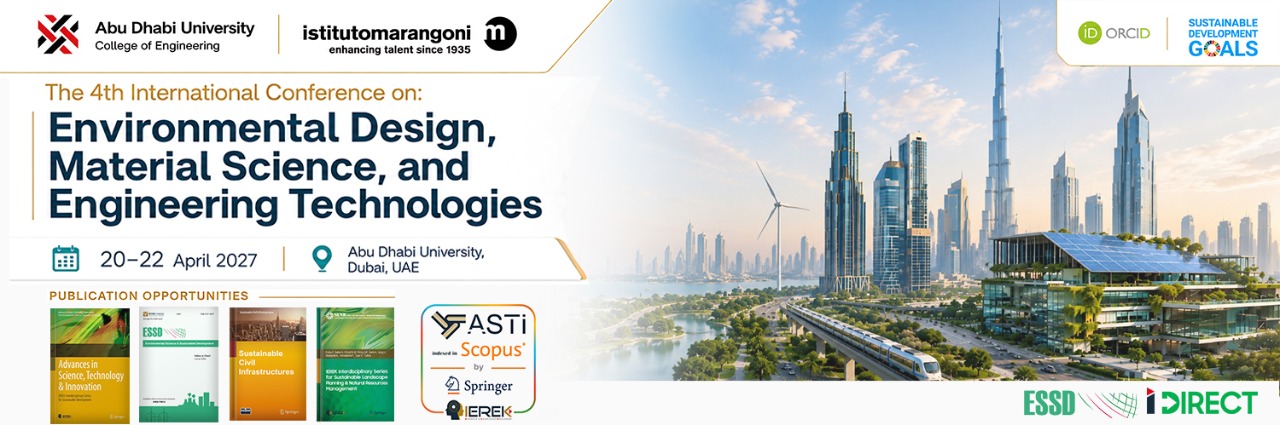
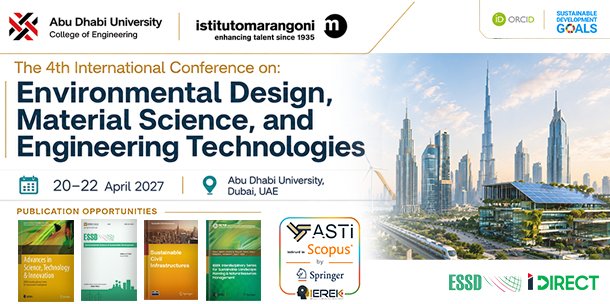
IEREK is proud to announce the 4th edition of the International conference on “Environmental Design, Material Science, and Engineering Technologies” (EDMSET). Building on the momentum of previous years, this edition aims to deepen the global dialogue on sustainable engineering practices. The conference will take place from April 20th to April 22nd, 2027, providing a premier platform for academic and professional exchange.
Conference Scope
EDMSET 2027 provides a dynamic forum for researchers, practitioners, and industry experts across the engineering spectrum. The scope encompasses the entire lifecycle of the built environment, from the molecular engineering of innovative materials to the macro-level planning of green urban spaces. Key areas of focus include the integration of Artificial Intelligence in material discovery, the circular economy in construction, and the development of carbon-neutral industrial processes.
Statement of Purpose
The primary objective of this conference is to facilitate an interdisciplinary exchange that translates theoretical research into actionable, sustainable solutions. By hosting keynote sessions, technical workshops, and collaborative panels, we aim to bridge the gap between materials research and environmental policy.
Join us on this intellectual journey as our mission is to inspire a forward-thinking community dedicated to designing a resilient, inclusive, and technologically advanced world where engineering serves the needs of both humanity and the planet.
1.1. Climate-Responsive Master Planning
1.2. Smart Cities and Technology Integration
1.3. Transit-Oriented Development (TOD)
1.4. Urban Heat Island (UHI) Mitigation
1.5. Smart Traffic Management Systems
1.6. Future Mobility and Autonomous Vehicles
1.7. Inclusive, Accessible, and Human-Centered Urban Design
1.8. Smart Governance and Urban Data Platforms
1.9. Climate Informatics and Urban Environmental Intelligence
1.10. Digital Carbon Accounting for Urban Systems
2.1. Bioclimatic and Passive Design Architecture
2.2. Net-Zero Energy Buildings (NZEB)
2.3. Biophilic Design and Environmental Psychology
2.4. Indoor Environmental Quality (IEQ)
2.5. Sustainable Interior Architecture and Furniture
2.6. Architectural Lighting and Environmental Acoustics
2.7. Adaptive Reuse and Sustainable Interior Retrofits
2.8. Smart and Connected Interior Spaces
2.9. Universal and Inclusive Interior Design
2.10. Healthy Buildings and Wellness-Centered Design
3.1. Digital Documentation and Restoration Technologies
3.2. Adaptive Reuse of Historic Buildings
3.3. Innovative Preservation Materials and Methods
3.4. Conservation Ethics and Legislative Frameworks
3.5. Cultural Sustainability in Urban Regeneration
3.6. Community Engagement in Heritage Management
3.7. Vernacular Architecture and Indigenous Building Knowledge
3.8. Structural Diagnosis and Monitoring of Historical Monuments
3.9. Climate Change Adaptation for Heritage Sites
4.1. Adaptive and Intelligent Structural Systems
4.2. Seismic Engineering and Structural Resilience
4.3. Sustainable Construction Practices in Structures
4.4. Advanced Infrastructure Materials
4.5. Structural Health Monitoring (SHM)
4.6. Predictive Analytics for Structural Life Extension
4.7. Climate-Resilient Infrastructure Design
4.8. Infrastructure Vulnerability Assessment
5.1. Robotics and Automation on Construction Sites
5.2. Large-Scale Additive Manufacturing (3D Printing)
5.3. Prefabrication and Modular Building Systems
5.4. Design for Disassembly (DfD) and Deconstruction
5.5. Life Cycle Assessment (LCA) of Built Assets
5.6. Advanced Building Information Modeling (BIM)
5.7. Construction Site Digitalization and IoT Monitoring
5.8. Construction Waste-to-Resource Technologies
5.9. Circular Supply Chains and Sustainable Material Procurement
6.1. Low-Carbon and Sustainable Cementitious Materials
6.2. Bio-Based Structural Composites
6.3. Smart Polymers and Responsive Functional Materials
6.4. Corrosion, Surface Chemistry, and Protective Coatings
6.5. Catalysis, Reaction Engineering, and Green Chemical Processes
6.6. Nanomaterials Synthesis, Characterization, and Applications
6.7. Recycled and Secondary Raw Materials in Structural Applications
6.8. Biomaterials and Bio-Inspired Material Engineering
7.1. Advanced Machining Processes and Precision Engineering
7.2. Automation, Robotics, and Intelligent Control Systems
7.3. Industrial Engineering & Process Optimization
7.4. Fluids & Thermal Engineering Optimization
7.5. Aerospace Engineering & Technology
7.6. Biomedical & Biotechnology Engineering
7.7. High-Performance Manufacturing Systems
7.8. Smart Factories and Industry 5.0
7.9. Sustainable Manufacturing and Resource Efficiency
7.10. Computational Fluid Dynamics (CFD) and Multi-Physics Simulation
8.1. Solar Energy Harvesting and Advanced Photovoltaics
8.2. Wind and Geothermal Energy Engineering
8.3. Energy Storage Innovations and Battery Technologies
8.4. Smart Grid Integration and Logistics
8.5. Sustainable Aviation Fuels (SAF) and Clean Hydrogen Infrastructure
8.6. Electrical Power Systems Optimization
8.7. Hydrogen Production, Storage, and Fuel Cell Systems
8.8. Small Modular Reactors (SMRs) and Advanced Nuclear Systems
9.1. Automation, Robotics, and Intelligent Control Systems
9.2. Smart Factories and Industry 5.0
9.3. Advanced Machining and Precision Engineering
9.4. Industrial Process Optimization and Lean Manufacturing
9.5. Sustainable Manufacturing and Resource Efficiency
9.6. Additive Manufacturing and Rapid Prototyping Systems
9.7. Supply Chain Resilience and Smart Logistics
10.1. Spatial Data Analysis and Geotechnical Mapping
10.2. Sustainable Subsurface Exploration and Drilling
10.3. Reservoir Engineering and Enhanced Recovery
10.4. Carbon Capture, Utilization, and Storage (CCUS)
10.5. Sustainable Mining and Minerals Processing
10.6. Petroleum Systems and Asset Integrity
10.7. Geological Hazard Assessment and Monitoring
10.8. Geo-Energy Systems and Underground Hydrogen Storage
10.9. Remote Sensing and Earth Observation Technologies
11.1. AI-Driven Material and Structural Optimization
11.2. Machine Learning Applications in Predictive Maintenance
11.3. Computer-Aided Engineering (CAE) and Simulation
11.4. Threat Modeling and Critical Infrastructure Cybersecurity
11.5. Secure Software Development Life Cycle (SDLC)
11.6. Ethical Considerations and Governance in Engineering AI
11.7. Edge AI and Embedded Intelligent Systems
11.8. Quantum Computing and Engineering Applications
11.9. Digital Twins and Intelligent Infrastructure Systems
11.10. Big Data Analytics and Decision Intelligence
12.1. Water Resource Engineering and Hydro-Conservation
12.2. Hydraulic and Sustainable Urban Drainage Systems (SUDS)
12.3. Ecosystem Conservation and Nature-Based Solutions
12.4. Carbon Footprint Management and Environmental Policy Frameworks
12.5. Environmental, Social, and Governance (ESG) Finance and Sustainable Economics
12.6. Smart Agriculture and Precision Farming Technologies
12.7. Food-Energy-Water Nexus Engineering
12.8. Humanitarian Engineering and Disaster Recovery Systems
12.9. Engineering Solutions for the Sustainable Development Goals (SDGs)
13.1. Occupational Health and Safety Management Systems
13.2. Ergonomics and Human Factors in Engineering Design
13.3. Risk Assessment and Mitigation Strategies
13.4. Innovations in Personal Protective Equipment (PPE)
13.5. Mental Health and Wellbeing in Engineering Work Environments
13.6. Emergency Response Planning and Crisis Management
14.1. Offshore Energy Solutions
14.2. Coastal Engineering and Flood Protection
14.3. Naval Architecture and Ship Powering
14.4. Port Infrastructure and Marine Logistics
14.5. Subsea Engineering and Pipeline Technology
14.6. The Blue Economy Innovation
14.7. Marine Environmental Monitoring Systems
14.8. Underwater Robotics and Autonomous Marine Vehicles
14.9. Coastal Smart Cities and Waterfront Resilience
14.10. Sustainable Fisheries and Ocean Resource Technologies
| Title | Date |
|---|---|
| Abstract Submission Deadline (1st round) | 15 Oct 2026 |
| Last Notification for Abstract Acceptance & Approval to present | 31 Oct 2026 |
| Early Payment Deadline | 31 Oct 2026 |
| Regular Payment Deadline | 15 Dec 2026 |
| Late Payment Deadline | 15 Feb 2027 |
| Full Paper Submission Deadline | 22 Feb 2027 |
| Notification of acceptance/rejection of full paper | 28 Feb 2027 |
| Conference Program | 22 Mar 2027 |
| Conference Launch | 22 Apr 2027 |
The registration fee does not cover accommodation or travel expenses. A list of accommodation options can be suggested by our team if available. Please contact [email protected] for inquiries.
We recommend that all authors take advantage of the benefits that IEREK offers, including various attendance types, publishing opportunities, and opportunities for discounts and waivers.
We are pleased to inform all applicants that they can use their previous publications to register for an IEREK membership, which offers a special discount.
IEREK offers a special discount to applicants from collaborative universities that have signed an MoU with IEREK to host or co-host one of its conferences.
IEREK also provides special discounts to authors from low and medium-income countries.
Book Series/ Journal(s) Discounts:
Some of the disclosed conference fees may vary depending on the book series and/or journal(s) presented as a publication outlet, as we encourage submission to newly founded book series and/or journal(s) by presenting a discounted rate for the conference's fees.
IEREK offers many alternative venues for publication. All accepted submissions to the conference, after a rigorous double-blinded peer-review process by the respective and highly distinguished Editorial Board, will be published through one of the following venues:
Accepted papers (according to the preference of the author) will be published through the Springer book series or a special issue in one of the IEREK press open-access Journals.
IEREK offers many types of registrations that are diverse in registration fees; applicants can choose the type they are familiar with as follows:
Participants who are PhD holders, post-doctoral researchers, and universities’ affiliated professors and experts in the field.
Must provide proof of enrollment in a university by providing an enrollment certificate and/or a valid university ID (with issue/expiry date) etc.
Participants who are not affiliated with universities such as practitioners, policymakers, entrepreneurs, etc.
Have access to the event to enjoy the discussions, coffee breaks, and lunch as a co-author or audience.
An author may need to attend the conference for presentation only to present a research idea without publication or full paper submission; the fee in this case will be decreased.
| Type of Registration | Early Payment Deadline 31 Oct 2026 |
Regular Payment Deadline 15 Dec 2026 |
Late Payment Deadline 15 Feb 2027 |
|---|---|---|---|
| Scopus indexed-ASTI Book by Springer | |||
| Student | 350 € | 400 € | 450 € |
| Academic | 400 € | 450 € | 500 € |
| Professional | 450 € | 500 € | 550 € |
| Co-author/ Audience | 200 € | 250 € | 300 € |
| Open Access IEREK Press Journals | |||
| Student | 250 € | 300 € | 350 € |
| Academic | 300 € | 350 € | 400 € |
| Professional | 350 € | 400 € | 450 € |
| Co-author/ Audience | 200 € | 250 € | 300 € |
IEREK offers various types of participation. Applicants can apply for in-person attendance to benefit fully from conference discussions and knowledge exchange.
IEREK also offers virtual attendance for authors to present their research papers online; however, we strongly encourage all applicants to attend the conference in person.
Type 1:
Through IEREK – Springer Nature Interdisciplinary book series “Advances in Science, Technology, and Innovation” (ASTI). See previous publication here.
Type 2:
The physical fee covers:
* Each research paper should have one main author who should pay the full fee (Author fees) regardless of attendance. Co-authors, each, have their fees to pay to attend the event. This applies to online attendance as well as physical attendance.
* A research paper fee allows only one author, whether main or co-author, to attend the conference and receive only one conference kit. Extras can be requested for an additional fee.
| Type of Registration | Early Payment Deadline 31 Oct 2026 |
Regular Payment Deadline 15 Dec 2026 |
Late Payment Deadline 15 Feb 2027 |
|---|---|---|---|
| Scopus indexed-ASTI Book by Springer | |||
| Student | 300 € | 350 € | 400 € |
| Academic | 350 € | 400 € | 400 € |
| Professional | 400 € | 450 € | 450 € |
| Co-author/ Audience | 100 € | 150 € | 200 € |
| Open Access IEREK Press Journals | |||
| Student | 200 € | 250 € | 300 € |
| Academic | 250 € | 300 € | 350 € |
| Professional | 300 € | 350 € | 400 € |
| Co-author/ Audience | 100 € | 150 € | 200 € |
IEREK offers virtual attendance, providing authors with a unique link to join the conference sessions and present their papers as per the announced program.
IEREK is dedicated to optimizing the benefits for each delegate so, similar to physical attendance, when it comes to virtual attendance IEREK also provides two venues for publication, which are:
Type 3:
Online attendance + Publication through Scopus Through IEREK – Springer Nature Interdisciplinary book series “Advances in Science, Technology, and Innovation” ASTI, see previous publications here.
Type 4:
The online fee covers:
* Each research paper should have one main author who should pay the full fee (Author fees) regardless of attendance.
* Co-authors, each, have their fees to pay to attend the event. This applies to online attendance as well as physical attendance.
* Participants can use only one type of discount opportunity, which meets their preferences.
* Authors should contact the conference manager through this email [email protected] to consider the discount and waiving for all the above cases so that the conference manager can provide an exclusive invoice for each case.
| Afghanistan, Algeria, Angola, Bangladesh, Benin, Bhutan, Bolivia, Burkina Faso, Burundi, Cabo Verde, Cambodia, Cameroon, Central African Republic, Chad, Comoros, Congo, Congo Dem. Rep., Côte d'Ivoire, Djibouti, Egypt, Eritrea, Eswatini, Ethiopia, Gambia, Ghana, Guinea, Guinea-Bissau, Haiti, Honduras, India, Iran, Jordan, Kenya, Kiribati, Kyrgyz Republic, Lao PDR, Lebanon, Lesotho, Liberia, Madagascar, Malawi, Mali, Mauritania, Micronesia, Mongolia, Morocco, Mozambique, Myanmar, Nepal, Nicaragua, Niger, Nigeria, Pakistan, Papua New Guinea, Philippines, Rwanda, Samoa, São Tomé and Principe, Senegal, Sierra Leone, Solomon Islands, Somalia, South Sudan, Sri Lanka, Sudan, Syria, Tajikistan, Tanzania, Timor-Leste, Togo, Tunisia, Uganda, Ukraine, Uzbekistan, Vanuatu, Vietnam, Yemen, Zambia, Zimbabwe |

iDirect is a new and efficient platform that allows direct submissions of research papers across various fields of science. iDirect accepts and covers all fields of science, not only those related to a particular conference. Individual authors are encouraged to submit their research discussing new ideas and presenting solutions to everyday problems that fall under numerous scientific themes. The iDirect platform is integrated into the peer review system for online conferences. You can publish your work through iDirect without the need to attend the conference or adhere to any submission deadlines. iDirect accepts a wide range of disciplines, eliminating the need to align with the conference's specific theme or scope. Based on the scope of your research, we will identify the most relevant proceedings for publication. The editor will schedule a discussion with you to review your presentation before proceeding to the peer-review process. Learn more here!
IEREK puts a lot of effort into expediting the peer review process to publish articles as quickly as possible. This requires prompt responses from all authors to the editors' comments, if any. Your swift response is highly appreciated to advance the production process and get your articles online. We prioritize the first author to respond as per our formula. The conference proceedings will be divided into multiple books, with the first one scheduled for publication within 3 months after the conference date. We encourage all authors to aim for publication in the first release.
For participants who need Entry Visas to the country where the conference will be held, IEREK will issue the corresponding invitation letter for accepted applicants to facilitate visa issuance. Please notice that we will attempt to assist you in obtaining a visa but the responsibility is yours and the decision rests solely with the appropriate Embassy. For the requirements of issuing a visa letter please read more here!
IEREK has an unyielding policy regarding plagiarism. We believe that copying/taking the ideas and work of other Authors without permission and credit is fraudulent. The Reviewing committee and IEREK employees have the authority to reject a paper during its reviewing process, based on the paper being subjected to either minor or major plagiarism.
Authors must refer to, and abide by, the following instructions in submitting their abstracts/ papers:
This is not a prerequisite for presenting your work at the conference. Meaning, you can present your submitted abstract without intending to publish your work.
This process can only be initiated after payment completion and confirmation:
Registration
To help the organizers plan for inter-disciplinary dialogue, participants are requested to choose from the conference themes/topics upon registration.
They must also refer to, and abide by, the following instructions in registering and/ or submitting their contributions:
NOTE: If you are contributing as an Author of a submitted abstract (for publishing consideration and/or presentation), and regardless of attendance, the fee for the registration is the same. See and Registrattion & Fees for more information.
Types of Participation
1. Attend/ Present in-person or Online and Publish in indexed Conference proceedings
The conference offers a Physical attendance option for your convenience. That said, participants will have a chance to present their abstract/research, on campus, and have their work considered for publication in the ASTI Series by Springer as part of the conference proceedings.
See Author Instructions and Registration & Fees for more information.
2. Registration to publish in the proceedings without presenting/ attending
If your full paper is accepted, it may be published in the conference proceedings book in the Advances in Science, Technology & Innovation Book Series by Springer (indexed in Scopus) even if you are not attending the conference. In this case, the accepted work will not be included in the final conference program. See Author Instructions and Publishing Opportunities for more information.
3. Non-presenting participant
Non-presenting participants may also wish to attend the conference as Audience Members or Co-authors contributing to an already submitted abstract/ paper. See Registration & Fees for more information.
Notes to consider:
* Attendance online and in-person are possible upon confirmation with the conference secretariat/ coordinator at [email protected] and following Registration & Fees covered.
* The participation fee is uninform for all options presented above.
* For participants wishing to attend in-person, a visa invitation letter will be provided upon request, for which case a copy of your passport will be required. The invitation letter can only be provided after acceptance and full payment.
* Before planning your trip, be sure to check travel restrictions to the conference’s hosting country. Visit travel information and restrictions, and send in your questions if you have any to the conference coordinator at the email [email protected]
All accepted submissions to the conference, after a rigorous double-blinded peer-review process by the respective and a highly-extinguished Editorial Board, will be published in one of the following:
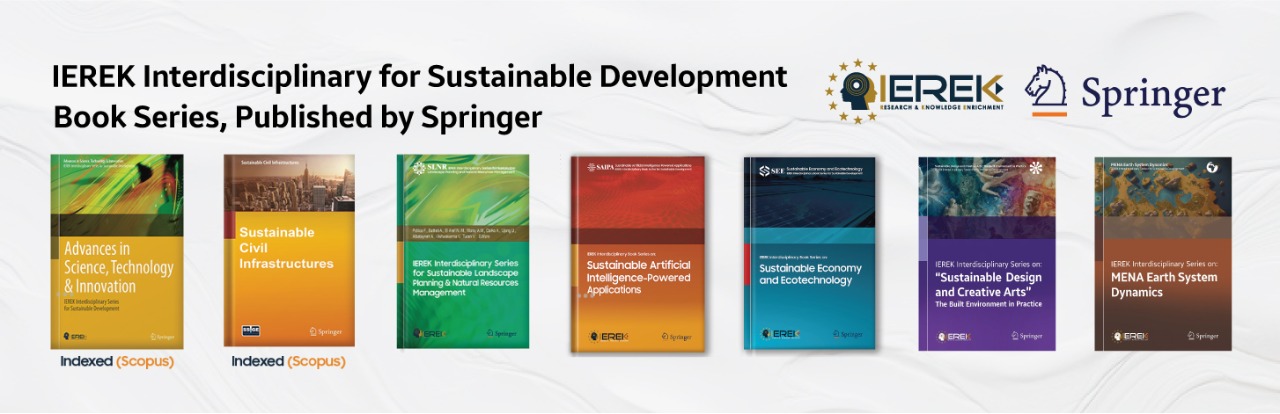
Advances in Science, Technology and Innovation (ASTI), an IEREK Interdisciplinary book series published by Springer Nature. (Scopus indexed) About ASTI
Advances in Science, Technology & Innovation (ASTI) is a series of peer-reviewed books based on important emerging research that redefines the current disciplinary boundaries in science, technology and innovation (STI) in order to develop integrated concepts for sustainable development. It not only discusses the progress made towards securing more resources, allocating smarter solutions, and rebalancing the relationship between nature and people, but also provides in-depth insights from comprehensive research that addresses the 17 sustainable development goals (SDGs) as set out by the UN for 2030.
The series draws on the best research papers from various IEREK and other international conferences to promote the creation and development of viable solutions for a sustainable future and a positive societal transformation with the help of integrated and innovative science-based approaches. Including interdisciplinary contributions, it presents innovative approaches and highlights how they can best support both economic and sustainable development, through better use of data, more effective institutions, and global, local and individual action, for the welfare of all societies. The series particularly features conceptual and empirical contributions from various interrelated fields of science, technology and innovation, with an emphasis on digital transformation, that focus on providing practical solutions to ensure food, water and energy security to achieve the SDGs. It also presents new case studies offering concrete examples of how to resolve sustainable urbanization and environmental issues in different regions of the world. Read More.
The ASTI series is fully indexed in Scopus and any chapter/ paper published as part of this series will be seen on the Scopus database. Some titles have been successfully indexed or submitted for indexation in Web of Science (ISI).
IEREK Press Journals, a multidisciplinary publisher that aims to cultivate and disseminate research.ESSD is a peer-reviewed, scholarly journal that aims to systematically develop the research-driven curiosity and evidence-based discourse of aspiring scholars that seek to contribute to the academic community. As the world is currently living in an age of information where sources are widely available on the Internet, we at ESSD seek to efficiently utilize the available information to help create robust and evidence-based knowledge. In the process, we offer researchers, in general, and young and aspiring ones in particular a quicker way to get their work published and gain exposure through online open access. We pride ourselves on getting submitted work to be published quickly, through the use of our worldwide pool of subject specialist peer reviewers. Find out more about ESSD International Journal here.
Attending a conference dramatically enhances both your professional and personal development. They help you sharpen the saw, meet and converse with industry experts, expand your resources and grow your professional network. IEREK Conference will help you:
|
Cancellation Policy |
Up to 60 days before the event |
Up to 50 days before the event |
Up to 40 days before the event |
39 days before the event |
|
Penalty |
20% |
50% |
70% |
100% |
EXCEPTION
A refund is not possible if
-An acceptance letter has been issued (Authors only)
-The proceedings of the event have been published (Authors only)
-All matters have been finalized (accommodation/travel expenses paid for)
Visa Rejection Cases
Reason and proof of rejection must be submitted. If the reason for rejection is due to an error on our part, the participant will be refunded their full fee with a deduction of a 20% administration fee.
Documents to be issued by IEREK to acquire a visa are as follows:
*Final Acceptance Letter (Authors only)
*Visa Invitation Letter
*Invoice/proof of payment
We encourage all authors and attendees to ensure their having acquired all documents (those applicable) mentioned.
If the reason for rejection is not related to any of the aforementioned and is an error on the participant’s part, the following will apply:
*Authors: may choose to let their co-author present his/her research on his/her behalf free of charge. If the author does not have a co-author, a member of the scientific committee shall present on the author’s behalf.
*Audience members/Registrants: will only be allowed to attend another similar event of their choosing that is organized by IEREK free of charge.
Subscribe to our newsletter
Join IEREK community