Sustainable Water Management, ...
Online Conference
17 Jun 2026 / 18 Jun 2026 read more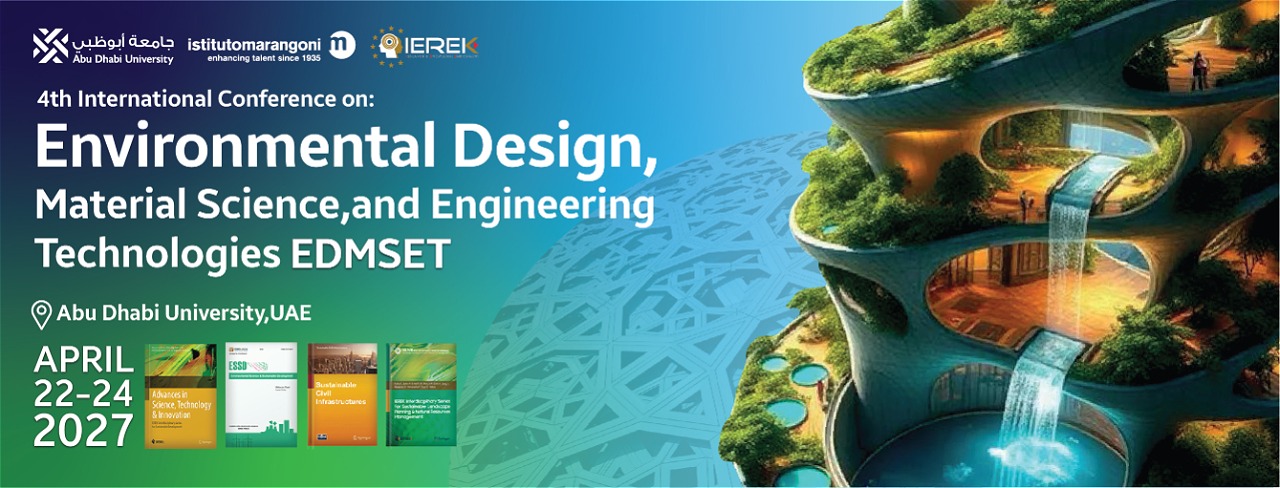
Subscribe to our newsletter


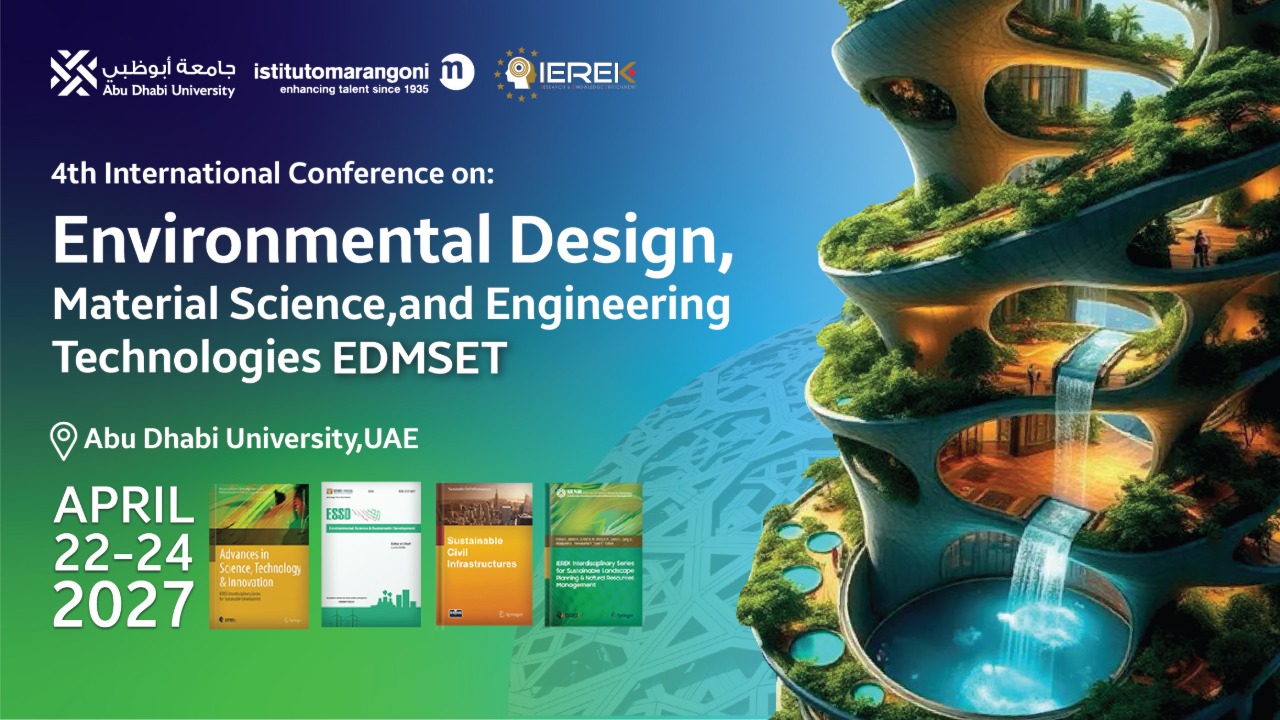
The 4th edition of the International Conference on Environmental Design, Material Science, and Engineering Technologies (EDMSET) acts as a catalyst for progress, supporting the collaborative engineering efforts that shape the infrastructure of today. Engineering continually propels the technologies that define our world. Its true power lies not just in individual feats, but in the collaborative synergy across its diverse disciplines. Fields such as mechanical, civil, and electrical engineering, among many others, work in concert, each contributing unique expertise to enhance the quality of life and advance civilization.
Within this collaborative framework, Materials Engineering emerges as a foundational discipline, driving advancements across a vast array of engineering domains. The critical importance of materials science is evident in its capacity to foster and support innovations in sectors as diverse as aerospace, biomedical research, and electronics. The core objective of materials science and engineering is to understand the fundamental physical properties of materials, enabling the development of novel and improved substances, the modification of existing ones, and the investigation of material failures. Recognizing the profound impact of materials engineering is crucial for appreciating how breakthroughs in this field ripple through and transform other engineering practices.
IEREK is delighted to announce the 4th edition of the EDMSET conference, which is building on the remarkable success of our previous events. This edition is poised to elevate discussions, challenge conventional thinking, and inspire innovative solutions for a sustainable future. We are particularly excited to hold this year's conference on April 22nd, 2027, at the Abu Dhabi University Dubai Campus, United Arab Emirates.
Conference Scope
This conference is meticulously designed to provide a dynamic platform for professionals, researchers, and enthusiasts across a wide range of engineering disciplines, including chemical engineering, materials science, environmental design, and industrial engineering. Our foremost goal is to cultivate an environment where participants can freely share insights and collaborate to address the pressing and multifaceted challenges within these interconnected fields.
Statement of Purpose
The conference seeks to establish an interactive and interdisciplinary forum for participants to explore recent advancements, exchange groundbreaking ideas, and collaboratively tackle the evolving challenges within these dynamic and rapidly advancing fields. Through engaging keynote presentations, interactive workshops, and collaborative discussions, we aim to strengthen cooperation and forward-thinking among all attendees. As we navigate the complex interplay of engineering disciplines and environmental considerations, this conference aspires to serve as a potent catalyst for transformative ideas and sustainable solutions that will shape our collective future.
Join us on this significant intellectual journey as we collectively strive to shape the future of environmental design, materials science, and engineering technologies. Our unwavering emphasis on innovative designs, sustainable practices, resilient infrastructure, and urban planning principles will ensure that our built environment aligns with the evolving needs of our communities and the planet.
This topic explores strategies for resilient, energy-efficient, and equitable urban environments. It includes net-zero building design, smart cities, and circular economy principles. Focus is on green infrastructure, urban heat island mitigation, and enhancing indoor environmental quality.
1.1. Net-Zero Energy Buildings: Design Strategies and Technologies
1.2. Smart Cities and Technology Integration in Urban Environments
1.3. Circular Economy Principles in Urban Design
1.4. Green Infrastructure and Urban Sustainability
1.5. Urban Heat Island Mitigation and Climate Adaptation Strategies
1.6. Building Information Modeling (BIM) and Digital Project Delivery
1.7. Resilient Urban Design: Strategies for Disaster Risk Reduction
1.8. Indoor Environmental Quality, Occupant Comfort, and Well-being
This topic examines advancements in diverse renewable energy sources and their grid integration. It covers solar, wind, geothermal, and hydropower optimization. The track also explores energy storage innovations and the role of smart technologies and AI in renewable energy management.
2.1. Solar Energy Harvesting and Next-Generation Photovoltaic Technologies
2.2. Advances in Wind Turbine Design and Efficiency, including Offshore and Vertical-Axis Systems
2.3. Energy Storage Innovations: Battery Technologies, Grid Integration, and Hydrogen Solutions
2.4. Geothermal Energy: Exploration, Utilization, and Advanced Systems
2.5. Sustainable Development and Deployment of Renewable Energy Systems
2.6. Hydropower Optimization and Modernization for Grid Stability
2.7. Smart Technologies and AI in Renewable Energy Integration and Management
This topic focuses on the development and application of advanced, sustainable materials. It investigates lifecycle performance, advanced composites, and eco-friendly construction materials. The track also covers responsive polymers, self-healing materials, corrosion protection, and bio-inspired materials, fostering sustainable design.
3.1. Sustainable Materials in Infrastructure Development: Lifecycle and Performance
3.2. Advanced Composite Materials for Structural and Lightweight Applications
3.3. Eco-Friendly Materials in Sustainable Construction and Prefabrication
3.4. Responsive Polymers, Smart Gels, and Self-Healing Materials for Advanced Applications
3.5. Corrosion Protection and Surface Engineering for Enhanced Durability
3.6. Advanced Steel Alloys for High-Performance Structural Applications
3.7. Bio-Inspired Materials and Biomimetics for Sustainable Design
This topic addresses comprehensive strategies and policies for environmental sustainability. It includes effective governance, carbon footprint reduction, and carbon capture technologies. Focus areas extend to waste reduction, circular economy practices, ecosystem conservation, water resource management, and integrating sustainable business models.
4.1. Environmental Policy and Governance for Sustainable Development
4.2. Carbon Footprint Reduction Strategies and Carbon Capture Technologies
4.3. Waste Reduction, Resource Recovery, and Circular Economy Practices
4.4. Ecosystem Conservation, Biodiversity Preservation, and Ecological Restoration
4.5. Water Resource Management, Desalination Innovations, and Conservation
4.6. Sustainable Business Models, Corporate Social Responsibility, and Green Finance
This topic investigates cutting-edge developments in resilient urban infrastructure. It covers adaptive structural systems, novel seismic and blast-resistant design, and sustainable, low-carbon construction. The track also discusses smart city integration, IoT, bioclimatic design, digital fabrication, and advanced construction robotics.
5.1. Adaptive Structural Systems for Changing Environments and Smart Response
5.2. Novel Approaches to Seismic Design, Blast Resistance, and Resilience
5.3. Sustainable Construction Practices and Low-Carbon Structural Engineering
5.4. Smart City Integration: IoT, Urban Connectivity, and Sensor Networks
5.5. Bioclimatic Design for Energy-Efficient Buildings and Thermal Comfort
5.6. Resilient Urban Infrastructure Planning, Design, and Maintenance
5.7. Digital Fabrication and Advanced Construction Robotics for Structures
This topic examines the pervasive impact of digital technologies on engineering. It highlights AI and Machine Learning in design optimization, predictive maintenance, and asset management. The track also covers digital twins, big data analytics, cloud computing, and XR for immersive training and collaboration.
6.1. The Role of Artificial Intelligence in Engineering Design and Optimization
6.2. Machine Learning Applications in Predictive Maintenance and Asset Management
6.3. Digital Twins for Real-Time Monitoring, Simulation, and Optimization of Assets
6.4. AI and Machine Learning for Structural Analysis and Material Characterization
6.5. Big Data Analytics and Cloud Computing for Engineering Decision-Making
6.6. Virtual, Augmented, and Mixed Reality in Engineering Training and Collaboration
This topic focuses on the future of transportation and mobility. It explores autonomous vehicles, integrated mobility services, sustainable planning, and intelligent infrastructure. The topic covers smart traffic management, electric/hybrid vehicle technologies, public transport innovations, and promotes active transportation solutions.
7.1. Future Trends in Autonomous Vehicles and Integrated Mobility Services
7.2. Sustainable Transportation Planning, Infrastructure Development and Policy
7.3. Smart Traffic Management Systems and Urban Mobility Optimization
7.4. Electric and Hybrid Vehicle Technologies: Charging Infrastructure and Grid Impact
7.5. Public Transportation Innovations, Accessibility, and Mass Transit Systems
7.6. Active Transportation, Pedestrian-Friendly Design, and Micro-Mobility Solutions
This topic addresses the critical need for building resilience against climate change impacts. It focuses on urban resilience planning, green infrastructure and nature-based adaptation solutions, and robust risk assessment. The track emphasizes community engagement, effective policy frameworks, and showcasing successful climate resilience projects.
8.1. Urban Resilience Planning for Extreme Weather Events and Climate Shocks
8.2. Green Infrastructure and Nature-Based Solutions for Climate Adaptation
8.3. Risk Assessment, Vulnerability Mapping, and Management for Climate Impact
8.4. Community Engagement and Participatory Approaches in Climate Resilience Initiatives
8.5. Policy Frameworks, Governance, and Funding Mechanisms for Climate Adaptation
8.6. Case Studies of Successful Climate Resilience Projects and Best Practices
This topic ensures safer and healthier environments within engineering projects. It covers occupational health and safety management, ergonomics, and advanced risk assessment. The track explores PPE innovations, addresses mental health, and discusses emergency response planning and crisis management, promoting holistic well-being.
9.1. Occupational Health and Safety Management Systems and Digital Tools
9.2. Ergonomics and Human Factors in Engineering Design for Performance and Safety
9.3. Advanced Risk Assessment and Mitigation Strategies in Complex Projects
9.4. Innovations in Personal Protective Equipment (PPE) and Smart Wearables
9.5. Mental Health Considerations, Stress Management, and Well-being in Engineering Workplaces
9.6. Emergency Response Planning, Crisis Management, and Business Continuity
This topic explores revolutionary technologies transforming the construction industry. It includes robotics, automation, and human-robot collaboration, alongside advancements in prefabrication and modular construction. The track covers innovative construction materials, 3D printing, and additive manufacturing, plus drones, AI, and remote sensing for site monitoring.
10.1. Robotics, Automation, and Human-Robot Collaboration in Construction
10.2. Prefabrication, Modular Construction Techniques, and Off-Site Manufacturing
10.3. Advances in Construction Materials and Smart Construction Components
10.4. 3D Printing and Additive Manufacturing Applications in Building and Infrastructure
10.5. Drones, AI, and Remote Sensing for Site Surveying, Monitoring, and Progress Tracking
10.6. Sustainable Practices and Digital Management in Construction Waste Management
This topic addresses the principles and applications of the circular economy within engineering. It covers design for disassembly, longevity, and end-of-life considerations. The topic explores waste minimization, industrial symbiosis, resource recovery, recycling, and material upcycling, alongside economic implications and policy frameworks.
11.1. Design for Disassembly, Longevity, and End-of-Life Strategies
11.2. Life Cycle Assessment (LCA) and Life Cycle Costing (LCC) in Engineering Projects
11.3. Waste Minimization Techniques and Industrial Symbiosis in Manufacturing
11.4. Resource Recovery, Recycling Technologies, and Material Upcycling
11.5. Economic Implications, Business Models, and Investment in Circular Economy Practices
11.6. Policy and Regulatory Frameworks for Transitioning to a Circular Economy
This topic examines the critical role of engineering and technology in safeguarding architectural heritage. It explores digital technologies (3D scanning, BIM for heritage) for conservation, and strategies for adaptive reuse and sustainable restoration. The track covers innovative materials, community engagement, and conservation ethics, highlighting successful preservation projects.
12.1. Digital Technologies (3D Scanning, BIM for Heritage) for Conservation and Restoration
12.2. Adaptive Reuse and Sustainable Restoration of Historic Buildings and Sites
12.3. Innovative Materials and Methods for Architectural Heritage Preservation and Repair
12.4. Community Engagement and Public Participation in Architectural Heritage Preservation
12.5. Conservation Ethics, Principles, and International Charters in Architectural Heritage
12.6. Case Studies in Successful Architectural Heritage Preservation Projects and Challenges
This topic highlights the latest developments and applications of materials derived from renewable resources. It covers biodegradable materials, natural fiber-reinforced composites, and biocomposites. The topic includes recycled/upcycled materials, life cycle analyses, and performance evaluation. It also explores market trends, policy drivers, and future directions for adoption.
13.1. Biodegradable Materials for Construction, Packaging, and Consumer Goods
13.2. Innovations in Natural Fiber Reinforced Composites and Biocomposites
13.3. Recycled and Upcycled Materials in Product Design and Manufacturing
13.4. Life Cycle Analysis of Renewable Materials: Environmental and Economic Impact
13.5. Performance Evaluation and Durability of Bio-based Materials
13.6. Market Trends, Policy Drivers, and Future Directions for Renewable Materials
This topic unpacks the transformative power of AI and ML across engineering applications. It covers predictive analytics, data mining, and AI-driven design optimization. The track also includes Natural Language Processing, Robotics Process Automation, and AI in infrastructure asset management. Ethical considerations and explainable AI are key discussions.
14.1. Predictive Analytics and Data Mining for Engineering Applications
14.2. AI-Driven Design Optimization Techniques and Generative Design
14.3. Natural Language Processing for Engineering Documentation, Knowledge Management, and Reporting
14.4. Robotics Process Automation (RPA) in Engineering Workflows and Manufacturing
14.5. AI in Infrastructure Asset Management, Predictive Maintenance, and Smart Monitoring
14.6. Ethical Considerations, Bias Mitigation, and Explainable AI in Engineering Applications
This topic explores the broader societal contributions and ethical responsibilities of engineering. It focuses on how projects drive community development, empower communities, and provide solutions for global challenges. The track highlights engineers' role in achieving SDGs, enhancing social equity, and fostering public engagement.
15.1. Community Development and Empowerment through Engineering Projects
15.2. Engineering Solutions for Global Challenges: Poverty, Health, and Education
15.3. The Role of Engineers in Achieving United Nations Sustainable Development Goals (SDGs)
15.4. Enhancing Social Equity and Accessibility through Inclusive Infrastructure Design
15.5. Public Engagement, Stakeholder Collaboration, and Citizen Science in Engineering Projects
15.6. Educational Initiatives to Promote Diversity and Inclusivity in Engineering Careers
This topic investigates the integration and application of geospatial technologies in engineering. It covers GIS for urban planning, environmental modeling, and infrastructure management. The track also explores remote sensing, spatial data analysis, 3D mapping, Digital Twin integration, location-based services, and ethical considerations in spatial data use.
16.1. Geographic Information Systems (GIS) in Urban Planning, Environmental Modeling, and Infrastructure Management
16.2. Remote Sensing and Satellite Imagery for Environmental Monitoring and Disaster Response
16.3. Spatial Data Analysis and Geostatistics for Infrastructure Development and Site Selection
16.4. 3D Mapping Technologies, Digital Elevation Models, and Digital Twin Integration
16.5. Location-Based Services, Real-Time Geolocation, and Smart Cities Applications
16.6. Geospatial Data Management, Data Security, and Ethical Considerations in Spatial Data Use
This topic addresses the paradigm shift towards Industry 4.0 and 5.0 in manufacturing. It covers smart factories, cyber-physical systems, and connected production lines. The track explores additive manufacturing, lean manufacturing, process optimization, and digitalization of supply chains. It also addresses sustainable practices and green operations in industrial facilities.
17.1. Industry 4.0 and 5.0: The Future of Manufacturing and Human-Centric Automation
17.2. Smart Factories, Cyber-Physical Systems, and Connected Production Lines
17.3. Additive Manufacturing (3D Printing) in Industrial Production and Prototyping
17.4. Lean Manufacturing Techniques, Six Sigma, and Process Optimization for Efficiency
17.5. Supply Chain Digitalization, Traceability, and Optimization for Resilience
17.6. Sustainable Practices, Energy Efficiency, and Green Operations in Industrial Facilities
This topic tackles the critical issue of protecting engineering systems from cyber threats, particularly in OT/ICS. It covers threat modeling, risk assessment, and vulnerability management. The track discusses secure software development, cybersecurity frameworks for critical infrastructure, incident response, and training, exploring emerging threats and AI-powered defenses.
18.1. Threat Modeling, Risk Assessment, and Vulnerability Management in Engineering Systems (OT/ICS)
18.2. Secure Software Development Life Cycle (SDLC) for Engineering Applications
18.3. Cybersecurity Frameworks, Standards, and Regulations for Critical Infrastructure Protection
18.4. Incident Response, Forensics, and Recovery Planning for Cyber Attacks
18.5. Training and Awareness Programs for Cybersecurity Best Practices in Engineering Workplaces
18.6. Emerging Trends in Cyber Threats, AI-Powered Defense, and Blockchain for Security
This topic explores the intersection of engineering practices with cultural heritage. It emphasizes integrating cultural heritage and traditional knowledge into urban development and designing solutions for cultural site preservation. The track highlights community participation in sustainable design and the interdisciplinary role of arts/humanities.
19.1. Integrating Cultural Heritage and Traditional Knowledge in Urban Development
19.2. Engineering Solutions for Cultural Site Preservation and Protection
19.3. Community Participation and Co-creation in Sustainable Design and Heritage Projects
19.4. The Role of Arts, Humanities, and Social Sciences in Engineering and Design
19.5. Evaluating Cultural Impact and Social Value in Engineering Projects
19.6. Policies and Frameworks for Promoting Cultural Sustainability in the Built Environment
This topic examines engineering's direct contributions to the UN Sustainable Development Goals. It encompasses innovations for clean water (SDG 6), sustainable energy (SDG 7), resilient infrastructure (SDG 9, 11), climate action (SDG 13), circular economy (SDG 12), zero hunger (SDG 2), and gender equality (SDG 5).
20.1. Engineering Innovations for Clean Water and Sanitation (SDG 6)
20.2. Sustainable Energy Access for All (SDG 7)
20.3. Building Resilient Infrastructure, Promoting Inclusive Cities, and Sustainable Industrialization (SDG 9, 11)
20.4. Climate Action through Engineering Solutions and Resilience Building (SDG 13)
20.5. Circular Economy, Responsible Consumption, and Production Patterns (SDG 12)
20.6. Engineering Solutions for Zero Hunger and Sustainable Agriculture (SDG 2)
20.7. Gender Equality and Inclusive Engineering Practices, Education, and Access (SDG 5)
20.8. Cross-Sectoral Approaches, Partnerships, and Policy Integration to Achieving the SDGs (SDG 17)
| Title | Date |
|---|---|
| Abstract Submission Deadline (1st round) | 15 Oct 2026 |
| Last Notification for Abstract Acceptance & Approval to present | 31 Oct 2026 |
| Early Payment Deadline | 31 Oct 2026 |
| Regular Payment Deadline | 15 Dec 2026 |
| Late Payment Deadline | 15 Feb 2027 |
| Full Paper Submission Deadline | 22 Feb 2027 |
| Notification of acceptance/rejection of full paper | 28 Feb 2027 |
| Conference Program | 22 Mar 2027 |
| Conference Launch | 22 Apr 2027 |
The registration fee does not cover accommodation or travel expenses. A list of accommodation options can be suggested by our team if available. Please contact [email protected] for inquiries.
We recommend that all authors take advantage of the benefits that IEREK offers, including various attendance types, publishing opportunities, and opportunities for discounts and waivers.
We are pleased to inform all applicants that they can use their previous publications to register for an IEREK membership, which offers a special discount.
IEREK offers a special discount to applicants from collaborative universities that have signed an MoU with IEREK to host or co-host one of its conferences.
IEREK also provides special discounts to authors from low and medium-income countries.
Book Series/ Journal(s) Discounts:
Some of the disclosed conference fees may vary depending on the book series and/or journal(s) presented as a publication outlet, as we encourage submission to newly founded book series and/or journal(s) by presenting a discounted rate for the conference's fees.
IEREK offers many alternative venues for publication. All accepted submissions to the conference, after a rigorous double-blinded peer-review process by the respective and highly distinguished Editorial Board, will be published through one of the following venues:
Accepted papers (according to the preference of the author) will be published through the Springer book series or a special issue in one of the IEREK press open-access Journals.
IEREK offers many types of registrations that are diverse in registration fees; applicants can choose the type they are familiar with as follows:
Participants who are PhD holders, post-doctoral researchers, and universities’ affiliated professors and experts in the field.
Must provide proof of enrollment in a university by providing an enrollment certificate and/or a valid university ID (with issue/expiry date) etc.
Participants who are not affiliated with universities such as practitioners, policymakers, entrepreneurs, etc.
Have access to the event to enjoy the discussions, coffee breaks, and lunch as a co-author or audience.
An author may need to attend the conference for presentation only to present a research idea without publication or full paper submission; the fee in this case will be decreased.
| Type of Registration | Early Payment Deadline 31 Oct 2026 |
Regular Payment Deadline 15 Dec 2026 |
Late Payment Deadline 15 Feb 2027 |
|---|---|---|---|
| Scopus indexed-ASTI Book by Springer | |||
| Student | 350 € | 400 € | 450 € |
| Academic | 400 € | 450 € | 500 € |
| Professional | 450 € | 500 € | 550 € |
| Co-author/ Audience | 200 € | 250 € | 300 € |
| Open Access IEREK Press Journals | |||
| Student | 250 € | 300 € | 350 € |
| Academic | 300 € | 350 € | 400 € |
| Professional | 350 € | 400 € | 450 € |
| Co-author/ Audience | 200 € | 250 € | 300 € |
IEREK offers various types of participation. Applicants can apply for in-person attendance to benefit fully from conference discussions and knowledge exchange.
IEREK also offers virtual attendance for authors to present their research papers online; however, we strongly encourage all applicants to attend the conference in person.
Type 1:
Through IEREK – Springer Nature Interdisciplinary book series “Advances in Science, Technology, and Innovation” (ASTI). See previous publication here.
Type 2:
The physical fee covers:
* Each research paper should have one main author who should pay the full fee (Author fees) regardless of attendance. Co-authors, each, have their fees to pay to attend the event. This applies to online attendance as well as physical attendance.
* A research paper fee allows only one author, whether main or co-author, to attend the conference and receive only one conference kit. Extras can be requested for an additional fee.
| Type of Registration | Early Payment Deadline 31 Oct 2026 |
Regular Payment Deadline 15 Dec 2026 |
Late Payment Deadline 15 Feb 2027 |
|---|---|---|---|
| Scopus indexed-ASTI Book by Springer | |||
| Student | 300 € | 350 € | 400 € |
| Academic | 350 € | 400 € | 400 € |
| Professional | 400 € | 450 € | 450 € |
| Co-author/ Audience | 100 € | 150 € | 200 € |
| Open Access IEREK Press Journals | |||
| Student | 200 € | 250 € | 300 € |
| Academic | 250 € | 300 € | 350 € |
| Professional | 300 € | 350 € | 400 € |
| Co-author/ Audience | 100 € | 150 € | 200 € |
IEREK offers virtual attendance, providing authors with a unique link to join the conference sessions and present their papers as per the announced program.
IEREK is dedicated to optimizing the benefits for each delegate so, similar to physical attendance, when it comes to virtual attendance IEREK also provides two venues for publication, which are:
Type 3:
Online attendance + Publication through Scopus Through IEREK – Springer Nature Interdisciplinary book series “Advances in Science, Technology, and Innovation” ASTI, see previous publications here.
Type 4:
The online fee covers:
* Each research paper should have one main author who should pay the full fee (Author fees) regardless of attendance.
* Co-authors, each, have their fees to pay to attend the event. This applies to online attendance as well as physical attendance.
* Participants can use only one type of discount opportunity, which meets their preferences.
* Authors should contact the conference manager through this email [email protected] to consider the discount and waiving for all the above cases so that the conference manager can provide an exclusive invoice for each case.
| Afghanistan, Algeria, Angola, Bangladesh, Benin, Bhutan, Bolivia, Burkina Faso, Burundi, Cabo Verde, Cambodia, Cameroon, Central African Republic, Chad, Comoros, Congo, Congo Dem. Rep., Côte d'Ivoire, Djibouti, Egypt, Eritrea, Eswatini, Ethiopia, Gambia, Ghana, Guinea, Guinea-Bissau, Haiti, Honduras, India, Iran, Jordan, Kenya, Kiribati, Kyrgyz Republic, Lao PDR, Lebanon, Lesotho, Liberia, Madagascar, Malawi, Mali, Mauritania, Micronesia, Mongolia, Morocco, Mozambique, Myanmar, Nepal, Nicaragua, Niger, Nigeria, Pakistan, Papua New Guinea, Philippines, Rwanda, Samoa, São Tomé and Principe, Senegal, Sierra Leone, Solomon Islands, Somalia, South Sudan, Sri Lanka, Sudan, Syria, Tajikistan, Tanzania, Timor-Leste, Togo, Tunisia, Uganda, Ukraine, Uzbekistan, Vanuatu, Vietnam, Yemen, Zambia, Zimbabwe |
iDirect is a new and efficient platform that allows direct submissions of research papers across various fields of science. iDirect accepts and covers all fields of science, not only those related to a particular conference. Individual authors are encouraged to submit their research discussing new ideas and presenting solutions to everyday problems that fall under numerous scientific themes. The iDirect platform is integrated into the peer review system for online conferences. You can publish your work through iDirect without the need to attend the conference or adhere to any submission deadlines. iDirect accepts a wide range of disciplines, eliminating the need to align with the conference's specific theme or scope. Based on the scope of your research, we will identify the most relevant proceedings for publication. The editor will schedule a discussion with you to review your presentation before proceeding to the peer-review process. Learn more here!
IEREK puts a lot of effort into expediting the peer review process to publish articles as quickly as possible. This requires prompt responses from all authors to the editors' comments, if any. Your swift response is highly appreciated to advance the production process and get your articles online. We prioritize the first author to respond as per our formula. The conference proceedings will be divided into multiple books, with the first one scheduled for publication within 3 months after the conference date. We encourage all authors to aim for publication in the first release.
For participants who need Entry Visas to the country where the conference will be held, IEREK will issue the corresponding invitation letter for accepted applicants to facilitate visa issuance. Please notice that we will attempt to assist you in obtaining a visa but the responsibility is yours and the decision rests solely with the appropriate Embassy. For the requirements of issuing a visa letter please read more here!
IEREK has an unyielding policy regarding plagiarism. We believe that copying/taking the ideas and work of other Authors without permission and credit is fraudulent. The Reviewing committee and IEREK employees have the authority to reject a paper during its reviewing process, based on the paper being subjected to either minor or major plagiarism.
Authors must refer to, and abide by, the following instructions in submitting their abstracts/ papers:
This is not a prerequisite for presenting your work at the conference. Meaning, you can present your submitted abstract without intending to publish your work.
This process can only be initiated after payment completion and confirmation:
Registration
To help the organizers plan for inter-disciplinary dialogue, participants are requested to choose from the conference themes/topics upon registration.
They must also refer to, and abide by, the following instructions in registering and/ or submitting their contributions:
NOTE: If you are contributing as an Author of a submitted abstract (for publishing consideration and/or presentation), and regardless of attendance, the fee for the registration is the same. See and Registrattion & Fees for more information.
Types of Participation
1. Attend/ Present in-person or Online and Publish in indexed Conference proceedings
The conference offers a Physical attendance option for your convenience. That said, participants will have a chance to present their abstract/research, on campus, and have their work considered for publication in the ASTI Series by Springer as part of the conference proceedings.
See Author Instructions and Registration & Fees for more information.
2. Registration to publish in the proceedings without presenting/ attending
If your full paper is accepted, it may be published in the conference proceedings book in the Advances in Science, Technology & Innovation Book Series by Springer (indexed in Scopus) even if you are not attending the conference. In this case, the accepted work will not be included in the final conference program. See Author Instructions and Publishing Opportunities for more information.
3. Non-presenting participant
Non-presenting participants may also wish to attend the conference as Audience Members or Co-authors contributing to an already submitted abstract/ paper. See Registration & Fees for more information.
Notes to consider:
* Attendance online and in-person are possible upon confirmation with the conference secretariat/ coordinator at [email protected] and following Registration & Fees covered.
* The participation fee is uninform for all options presented above.
* For participants wishing to attend in-person, a visa invitation letter will be provided upon request, for which case a copy of your passport will be required. The invitation letter can only be provided after acceptance and full payment.
* Before planning your trip, be sure to check travel restrictions to the conference’s hosting country. Visit travel information and restrictions, and send in your questions if you have any to the conference coordinator at the email [email protected]
All accepted submissions to the conference, after a rigorous double-blinded peer-review process by the respective and a highly-extinguished Editorial Board, will be published in one of the following:
 Advances in Science, Technology and Innovation (ASTI), an IEREK Interdisciplinary book series published by Springer Nature. (Scopus indexed)
 About ASTI
Advances in Science, Technology & Innovation (ASTI) is a series of peer-reviewed books based on important emerging research that redefines the current disciplinary boundaries in science, technology and innovation (STI) in order to develop integrated concepts for sustainable development. It not only discusses the progress made towards securing more resources, allocating smarter solutions, and rebalancing the relationship between nature and people, but also provides in-depth insights from comprehensive research that addresses the 17 sustainable development goals (SDGs) as set out by the UN for 2030.
The series draws on the best research papers from various IEREK and other international conferences to promote the creation and development of viable solutions for a sustainable future and a positive societal transformation with the help of integrated and innovative science-based approaches. Including interdisciplinary contributions, it presents innovative approaches and highlights how they can best support both economic and sustainable development, through better use of data, more effective institutions, and global, local and individual action, for the welfare of all societies. The series particularly features conceptual and empirical contributions from various interrelated fields of science, technology and innovation, with an emphasis on digital transformation, that focus on providing practical solutions to ensure food, water and energy security to achieve the SDGs. It also presents new case studies offering concrete examples of how to resolve sustainable urbanization and environmental issues in different regions of the world. Read More.
The ASTI series is fully indexed in Scopus and any chapter/ paper published as part of this series will be seen on the Scopus database. Some titles have been successfully indexed or submitted for indexation in Web of Science (ISI).
 IEREK Press Journals, a multidisciplinary publisher that aims to cultivate and disseminate research.
ESSD is a peer-reviewed, scholarly journal that aims to systematically develop the research-driven curiosity and evidence-based discourse of aspiring scholars that seek to contribute to the academic community. As the world is currently living in an age of information where sources are widely available on the Internet, we at ESSD seek to efficiently utilize the available information to help create robust and evidence-based knowledge. In the process, we offer researchers, in general, and young and aspiring ones in particular a quicker way to get their work published and gain exposure through online open access. We pride ourselves on getting submitted work to be published quickly, through the use of our worldwide pool of subject specialist peer reviewers. Find out more about ESSD International Journal here.
Attending a conference dramatically enhances both your professional and personal development. They help you sharpen the saw, meet and converse with industry experts, expand your resources and grow your professional network. IEREK Conference will help you:
|
Cancellation Policy |
Up to 60 days before the event |
Up to 50 days before the event |
Up to 40 days before the event |
39 days before the event |
|
Penalty |
20% |
50% |
70% |
100% |
EXCEPTION
A refund is not possible if
-An acceptance letter has been issued (Authors only)
-The proceedings of the event have been published (Authors only)
-All matters have been finalized (accommodation/travel expenses paid for)
Visa Rejection Cases
Reason and proof of rejection must be submitted. If the reason for rejection is due to an error on our part, the participant will be refunded their full fee with a deduction of a 20% administration fee.
Documents to be issued by IEREK to acquire a visa are as follows:
*Final Acceptance Letter (Authors only)
*Visa Invitation Letter
*Invoice/proof of payment
We encourage all authors and attendees to ensure their having acquired all documents (those applicable) mentioned.
If the reason for rejection is not related to any of the aforementioned and is an error on the participant’s part, the following will apply:
*Authors: may choose to let their co-author present his/her research on his/her behalf free of charge. If the author does not have a co-author, a member of the scientific committee shall present on the author’s behalf.
*Audience members/Registrants: will only be allowed to attend another similar event of their choosing that is organized by IEREK free of charge.













Subscribe to our newsletter
Join IEREK community