



Why Nature-Based Solutions (NBS) are the Future of Climate Adaptation

The policy landscape for NBS in MENA is rapidly evolving. Countries are beginning to recognize that blue and green infrastructure, such as restoring coastal wetlands (blue) and expanding urban green spaces (green), offer multiple benefits. These solutions not only sequester carbon and enhance biodiversity but also provide essential services like flood control, reduced urban heat island effects, and improved water quality. However, the adoption remains fragmented. A comparative study of national policies reveals that while high-level commitments exist, the regulatory mechanisms needed to mainstream NBS into urban planning, water management, and national climate strategies are often underdeveloped or siloed 3
Policy Frameworks for Carbon Sequestration: Bridging the Gap

A major policy gap in the region is the absence of standardized MRV (Measurement, Reporting, and Verification) systems for NBS projects. Without rigorous MRV protocols, the carbon benefits of mangrove restoration, reforestation, or wetland rehabilitation cannot be certified, preventing these projects from accessing carbon markets or attracting private investment. National policies need to establish clear legal and financial pathways that allow NBS projects to generate verifiable carbon credits, thereby attracting private sector investment and accelerating the adoption of Nature-Based Solutions (NBS) in the MENA Region.
Comparative Analysis: Regulatory Mechanisms for Blue and Green Infrastructure
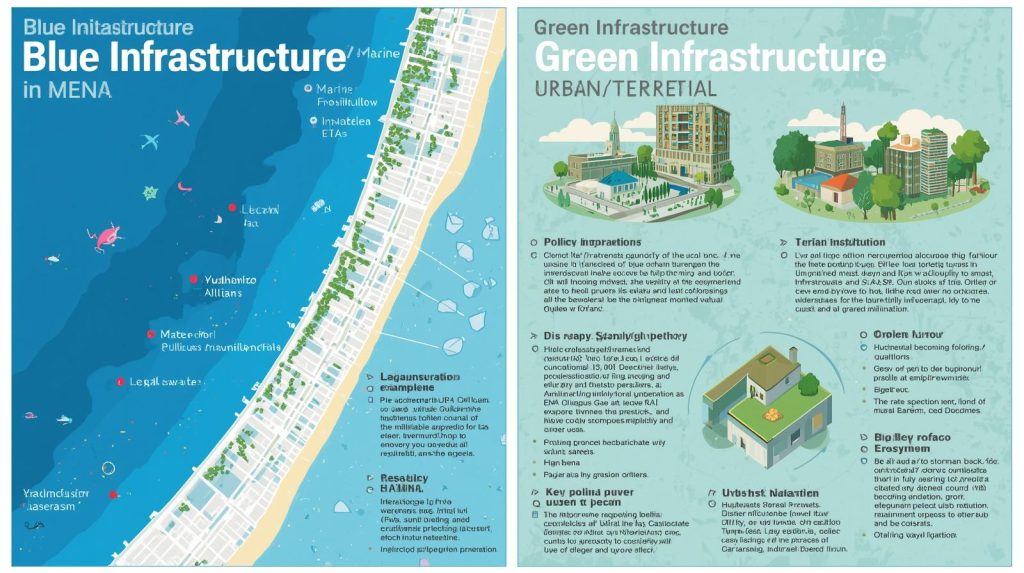
A comparative study across MENA nations highlights divergent approaches to integrating blue and green infrastructure:
| Policy Mechanism | Blue Infrastructure (Coastal/Marine) | Green Infrastructure (Urban/Terrestrial) |
| Legal Integration | Often governed by fragmented marine protection laws or environmental impact assessments (EIAs). | Increasingly integrated into municipal zoning and urban planning codes (e.g., mandatory green roofs). |
| Financial Incentives | Limited, often relying on international grants or public sector funding for restoration projects. | Growing use of green bonds, tax breaks, or subsidies for private developers to incorporate green spaces. |
| Key Policy Drivers | Biodiversity conservation and coastal protection. | Urban heat mitigation and air quality improvement. |
To accelerate the adoption of Nature-Based Solutions (NBS) in the MENA Region, policymakers must move beyond project-by-project approvals. They need to create systemic regulatory mechanisms that mandate the consideration of NBS as the default option for climate adaptation and mitigation, especially in coastal and urban development. This requires cross-sectoral collaboration between environment, urban planning, and finance ministries.
The Diplomatic and Scientific Imperative
The development of robust policy frameworks for NBS and carbon sequestration is not just a national concern; it is a regional imperative. Many of the most effective NBS, such as large-scale desert greening or marine conservation, require transboundary cooperation. The “Green Blue Deal” concept for the Middle East, for example, emphasizes harnessing regional resources like solar energy and the sea to create shared water and energy security, which inherently supports blue and green infrastructure 6
The scientific community plays a crucial role in informing these policy shifts. Research must focus on localizing global NBS best practices to the hyper-arid and semi-arid conditions of MENA, providing policymakers with the evidence base needed to justify large-scale investment. This includes research on drought-resistant native species for afforestation and the optimal design of urban green corridors to maximize cooling effects.
The MESC Congress is the ideal forum for this critical dialogue. By bringing together earth scientists, policy experts, and industry leaders, we can translate cutting-edge research into actionable regulatory mechanisms that drive the widespread adoption of Nature-Based Solutions (NBS) in the MENA Region.
Do you have insights into policy gaps, regulatory challenges, or successful models for advancing blue and green infrastructure in the MENA region? Your expertise can help shape a stronger, evidence-based regional climate agenda.
Submit your abstract for the MENA Earth Science Congress (MESC): https://www.ierek.com/events/mena-earth-science-congress-mesc
References
[5] Saudi Green Initiative. (n.d.). Information About Middle East Green Initiative.
[6] EcoPeace Middle East. (2020). A Green Blue Deal for the Middle East.
