



AI in architecture is quietly rewriting how buildings are designed, tested, and built. What once took months now happens in hours, and firms that embrace AI move faster, waste less, and design better buildings.
Today, artificial intelligence doesn’t sit on the sidelines. It sketches, simulates, optimizes, and sometimes outperforms human assumptions. Firms that embrace it move faster, waste less, and design better buildings. Firms that resist it struggle to keep up with clients who now expect data-backed design decisions.
This isn’t theory. It’s already happening on real projects, in real cities, with real budgets.
The Quiet Shift From Intuition to Intelligence
Architects have always used tools. The difference now? Tools think back.
AI systems analyze thousands of design variables at once, daylight, wind, energy loads, zoning limits, and material costs, before the first concept presentation. What once took weeks now happens in hours.
Instead of asking “Does this work?”, architects ask “Which option works best, and why?”
That shift changes everything.
Case Study: Autodesk’s Generative Design Changed Office Planning Forever
Autodesk ran a simple experiment on its Toronto office. Designers defined goals: maximize daylight, improve collaboration, reduce walking distance, and respect building codes.
Then they let AI generate thousands of layout options.
The system didn’t replace designers. It gave them better choices.
Results:
- 14% increase in face-to-face collaboration
- Fewer blind spots in circulation
- Faster decision-making with measurable proof
![Autodesk’s new office in Toronto is the first large-scale example of a generatively designed office space.]()

Designers selected the best-performing option, not the most familiar one. That office still operates as a benchmark for data-driven workplace design.
How Zaha Hadid Architects Uses AI Without Losing Creativity
Critics often say AI kills creativity. Zaha Hadid Architects proves the opposite.
The firm uses machine learning to test complex geometries, structural logic, and environmental performance, especially on large-scale projects where intuition alone breaks down.
On projects like the Beijing Daxing International Airport, AI-assisted modeling helped:
- Optimize structural efficiency
- Reduce material waste
- Maintain bold, fluid forms without guesswork
![Beijing Daxing International Airport featuring Zaha Hadid–inspired futuristic architecture with sweeping curves, radial geometry, and advanced digital design innovation.]()
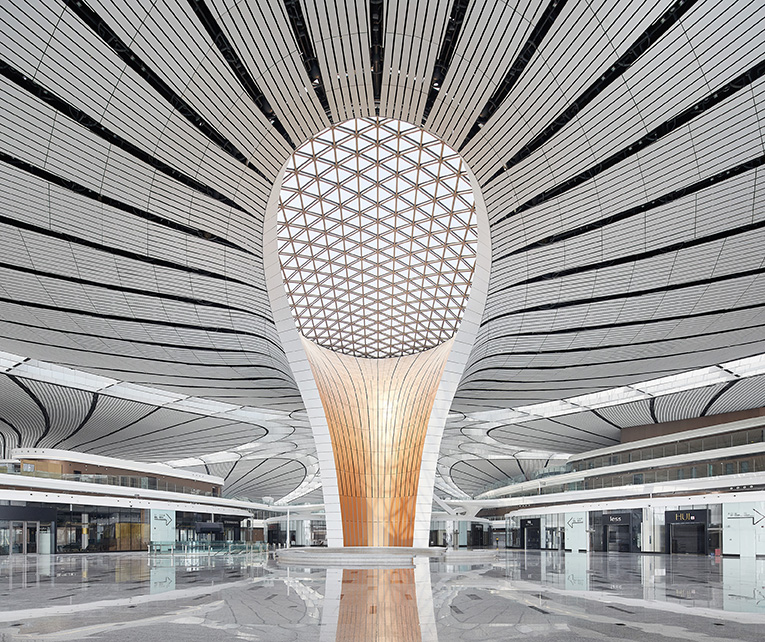
The creativity stayed human. AI handled the math that creativity depends on.
The Rise of AI-Powered Urban Planning
Cities now grow faster than planning departments can react. AI fills that gap.
Case Study: Spacemaker (Now Autodesk Forma)
Spacemaker uses AI to analyze urban sites in minutes. It evaluates sunlight, noise, wind, density, and livability before zoning even enters the conversation.
Developers in Oslo used it to redesign housing layouts that:
- Increased daylight access by over 20%
- Reduced noise exposure across units
- Preserved views without increasing height
Architects didn’t lose control. They gained leverage.
Sustainability Got Serious When AI in architecture Entered the Room
Green design used to rely on rules of thumb. AI replaced guesses with simulations.
Case Study: Sidewalk Labs’ Environmental Modeling
Before Google shut down Sidewalk Labs’ Toronto project, the team tested AI-driven energy modeling at an urban scale.
The system simulated:
- Building energy use across seasons
- Microclimate effects between towers
- Material choices and lifecycle emissions
![Sidewalk Labs’ environmental modeling visualizing AI-driven analysis of urban climate, energy performance, and sustainable design scenarios in a smart city context.]()
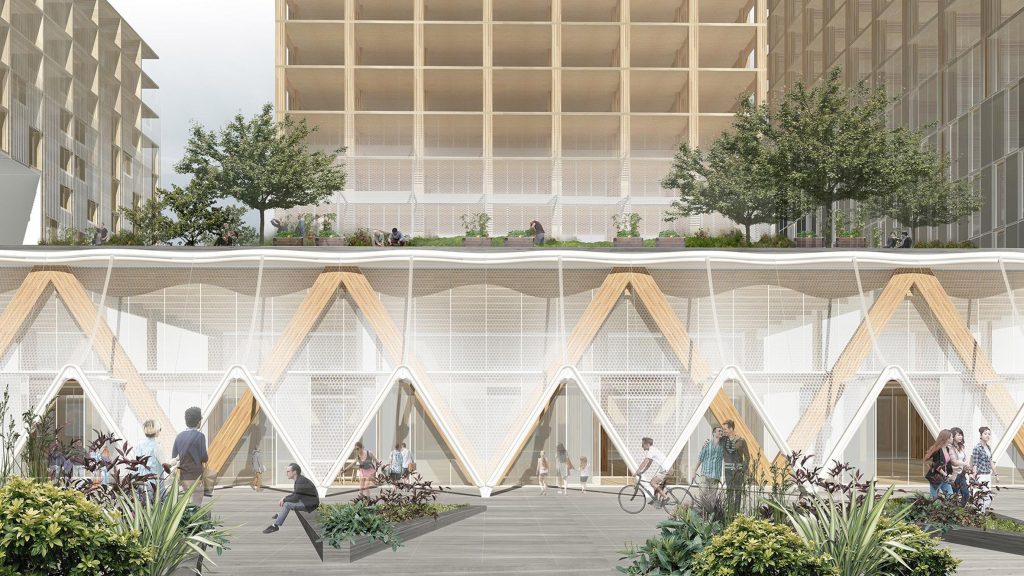
The models exposed inefficiencies early, when fixing them still cost little.
That lesson stuck across the industry.
What AI Actually Does Better Than Humans
AI doesn’t replace architects. It replaces bad assumptions.
It excels at:
- Exploring thousands of options without bias
- Detecting performance tradeoffs humans miss
- Optimizing layouts under complex constraints
- Predicting long-term building behavior
Humans still lead vision, ethics, culture, and experience. AI just refuses to ignore inconvenient data.
Why Smaller Firms Benefit the Most
Big firms adopted AI first. Smaller studios now gain the most.
Cloud-based tools remove the need for massive R&D budgets. A five-person studio can now:
- Run energy simulations early
- Compete with larger firms on performance
- Present data-backed designs to skeptical clients
Clients trust numbers. AI helps architects speak that language fluently.
The Risk of Doing Nothing
Here’s the uncomfortable truth: clients already assume AI is part of the process.
When architects can’t explain why a design performs well, someone else will. Engineers, consultants, or design-build firms already step into that gap.
Ignoring AI doesn’t preserve tradition. It hands influence away.
What the Future of Architecture Looks Like
The next generation of architects won’t ask whether to use AI. They’ll ask how well they can direct it.
Firms that thrive will:
- Design faster without rushing
- Justify decisions with evidence
- Reduce waste before construction starts
- Combine intuition with intelligence
That combination defines the future of the profession.
Final Thought
Architecture never lost its soul to technology. It gained sharper tools.
The firms winning today don’t design with AI as a gimmick. They design through it as a strategic advantage. And that shift? It’s already irreversible.
This topic aligns with the core themes of the Sustainability in Creative Industries (SCI) – 5th Edition conference, the conference will be Online In Collaboration with Universitas Ciputra Indonesia on 03-04 November 2026, which brings together researchers and practitioners to explore innovative, responsible, and transformative approaches that embed sustainability across creative sectors. By fostering dialogue on sustainable practices, the conference offers an essential platform for advancing knowledge exchange and inspiring collaborative solutions in sustainable media production and creative industries.
Q&A: Rethinking Architecture in the Age of AI
Can a machine really make better design decisions than an architect?
Not alone, but it can reveal insights humans miss, allowing architects to choose smarter, evidence-backed solutions.
What if the most important design decisions are made before the first sketch?
That’s where AI excels, testing daylight, energy, form, and performance in hours instead of months.
Is AI a luxury tool for global firms, or a weapon for small studios?
Today, it’s a competitive equalizer, giving smaller practices access to high-level simulations and credibility.
Does optimization kill creativity, or unlock it?
By removing uncertainty, AI actually frees architects to explore more ambitious forms with confidence.
When did sustainability stop being an opinion and become measurable?
The moment AI-driven simulations replaced rules of thumb with real performance data.
Why are researchers paying close attention now?
Because AI is reshaping how architecture proves value, sustainability, and impact—core questions driving current academic research and conferences like SCI.
